10/1/18

Matthew 18:15-17 and Responding to Public Sin by Trevor Bowen

http://insearchoftruth.org/articles/matthew_18_and_public_sin.html

Matthew 18:15-17 and Responding to Public Sin

Introduction

“But, have you talked to them first? That is the process Jesus requires of us according to Matthew 18:15-17! If you have not talked to them first, then you need to keep quiet!” Have you heard someone say something like this? Or, have you argued this point yourself? There certainly is a protocol that Jesus outlines in Matthew 18:15-17 about correcting brethren in sin, but when should it be applied? Does this passage apply to how Christians and churches should handle public sins, including moral trespasses and false teaching? Since this is a commonly made point, let us look to the Scriptures to understand this frequently misused passage and its intended application.

Examining the Immediate Context

First, let us set before us the passage under question:
“Moreover if your brother sins against you, go and tell him his fault between you and him alone. If he hears you, you have gained your brother. But if he will not hear, take with you one or two more, that ‘by the mouth of two or three witnesses every word may be established.’ And if he refuses to hear them, tell it to the church. But if he refuses even to hear the church, let him be to you like a heathen and a tax collector.” (Matthew 18:15-17)
Please notice that the qualifying condition is, “if your brother sins against you. Immediately, this disqualifies all public trespasses and public proclamation of error from direct application of this passage. The qualifying condition simply does not match. In both forms of public trespass, the sin to be addressed is not a simple matter against an individual. Rather, it is a trespass against God and His people in a given church - or possibly even multiple churches! If we can ignore the qualifying limitations in this passage, can we not rightly ignore them in every passage? But, if we must observe them everywhere, must we not also observe them here? May we always be consistent in our interpretation of Scripture.
Now, if someone insists that public sin, whether in teaching or in morality, constitutes a sin against every individual in the public community, thereby bringing it into jurisdiction of Matthew 18:15-17, then let such a person also accept that every single individual in the community is equally obligated to appear on the sinner's doorstep, knock on his or her door, and privately offer rebuke of the public sin. From the elder to the child, each is equally injured; therefore, each is equally obligated. (However, one should recognize the elder and more spiritual are obligated first, Galatians 6:1II Corinthians 12:14b). Furthermore, if this is indeed the requirement, then how is it any different than being confronted by the whole church (the last step in Matthew 18:17), since the whole church has already confronted the sinner during the first step? Clearly, such an argument proves “too much”, while also contradicting the context.

Inadequate Resolution

Often people look to Matthew 18:15-17 and apply it in hopes that a public sin may be resolved entirely by one individual’s private confrontation of the sinning brother. But, is that possible whenever sins are publicly known or false doctrine is publicly spread? Is private resolution completely adequate for a public sin? Or, must something more be done?
Whenever one sins privately against an individual or even multiple individuals, the sinner may repent and confess his sin to those he has sinned against thereby resolving the matter:
Confess your trespasses to one another, and pray for one another, that you may be healed. The effective, fervent prayer of a righteous man avails much. (James 5:16)
However, whenever one sins publicly, there are multiple repercussions besides the injury of those directly inflicted:
You, therefore, who teach another, do you not teach yourself? You who preach that a man should not steal, do you steal? You who say, "Do not commit adultery," do you commit adultery? You who abhor idols, do you rob temples? You who make your boast in the law, do you dishonor God through breaking the law? For "the name of God is blasphemed among the Gentiles because of you," as it is written. (Romans 2:21-24)
"'For you did it secretly, but I will do this thing before all Israel, before the sun.'" So David said to Nathan, "I have sinned against the LORD." And Nathan said to David, "The LORD also has put away your sin; you shall not die. However, because by this deed you have given great occasion to the enemies of the LORD to blaspheme, the child also who is born to you shall surely die." (II Samuel 12:12-14)
They have provoked Me to jealousy by what is not God; They have moved Me to anger by their foolish idols. But I will provoke them to jealousy by those who are not a nation; I will move them to anger by a foolish nation. For a fire is kindled by my anger, And shall burn to the lowest hell; It shall consume the earth with her increase, And set on fire the foundations of the mountains. ... I would have said, "I will dash them in pieces, I will make the memory of them to cease from among men," Had I not feared the wrath of the enemy, Lest their adversaries should misunderstand, Lest they should say, "Our hand is high; And it is not the LORD who has done all this."' (Deuteronomy 32:21-27)
“I do not pray for these alone, but also for those who will believe in Me through their word; that they all may be one, as You, Father, are in Me, and I in You; that they also may be one in Us, that the world may believe that You sent Me.” (John 17:20-21)
The Lord has consistently shown great concern for the tarnishing of His name. Whenever Christians - disciples wearing His name - behave inconsistently, manifest hypocrisy, and divide selfishly, we also generate “great occasion to the enemies of the LORD to blaspheme”. This not only dishonors our God publicly, but it also provides an excuse, a “stumbling block of offense” for people to avoid turning to the Lord, since His own self-professed people are seemingly, arguably not any better. Does anyone want to appear before the Lord with such a condemnation hung around his neck (Matthew 18:6-8)?
If public shame and reproach has been brought on the Lord, His Word, or His people, how can it be resolved in private? What else but public admission can answer the charges of inconsistency and hypocrisy?
Furthermore, in the case of public false teaching, there is another great concern: What effect will the public false teaching continue to have through its own persuasiveness or the reputation, influence, and charisma of its proclaimer?
... holding fast the faithful word as he has been taught, that he may be able, by sound doctrine, both to exhort and convict those who contradict. For there are many insubordinate, both idle talkers and deceivers, especially those of the circumcision, whose mouths must be stopped, who subvert whole households, teaching things which they ought not, for the sake of dishonest gain. One of them, a prophet of their own, said, "Cretans are always liars, evil beasts, lazy gluttons." This testimony is true. Therefore rebuke them sharply, that they may be sound in the faith, (Titus 1:9-13)
But shun profane and idle babblings, for they will increase to more ungodliness. And their message will spread like cancer. Hymenaeus and Philetus are of this sort, who have strayed concerning the truth, saying that the resurrection is already past; and they overthrow the faith of some. (II Timothy 2:16-18)
Although the measure of deceitfulness in a false teacher may govern the measure of sharpness in rebuking him, rebuke must occur none the less, because false teachers’ “mouths must be stopped”! Now, even if a false teacher could be privately persuaded of his error, when false doctrine is proclaimed publicly, it takes on a life of its own, “spreading like cancer”. (Incidentally, this is the primary distinction between private and public sins. Private sins may be known to others, but public sins have escaped one's ability to individually identify those affected.) In any instance of public sin, who can truly say how far error has spread? How will it be stopped without public correction, confession, and retraction?
Furthermore, what about the already “subverted households” and souls with “faith overthrown”? How will they be restored, if the public error is not publicly refuted or retracted? Therefore, such a matter cannot be ultimately resolved privately. Whenever false teaching has been publicly proclaimed, or whenever public sin has been allowed to “leaven the lump” (I Corinthians 5), it must also be publicly corrected; otherwise, the damaging error and influential sin is left to propagate unchecked. Public sins ultimately cannot be resolved privately. Therefore, let us not misapply Matthew 18:15-17 to delay or condemn immediate and public confrontation, which alone can hope to stem the tide.

Discretion and Expediency

Now, does this need for public response to public sin require that we immediately, publicly blast every infraction regardless of circumstances? The Scriptures indicate otherwise:
Now we exhort you, brethren, warn those who are unrulycomfort the fainthearteduphold the weak, be patient with all. (I Thessalonians 5:14)
And on some have compassion, making a distinction; but others save with fear, pulling them out of the fire, hating even the garment defiled by the flesh. (Jude 22-23)
Clearly, we do not treat everyone the exact same way regardless of all circumstances. Some measure of judgment and discretion is required to “distinguish” if one is “unruly, fainthearted, or weak”. If a person is young in Christ, or if a relationship already exists, then private correspondence may convince a person to publicly correct or clarify his public mistake. The example of Aquila, Priscilla, and Apollos exemplify this very discretion:
Now a certain Jew named Apollos, born at Alexandria, an eloquent man and mighty in the Scriptures, came to Ephesus. This man had been instructed in the way of the Lord; and being fervent in spirit, he spoke and taught accurately the things of the Lord, though he knew only the baptism of John. So he began to speak boldly in the synagogue. When Aquila and Priscilla heard him, they took him aside and explained to him the way of God more accurately. And when he desired to cross to Achaia, the brethren wrote, exhorting the disciples to receive him; and when he arrived, he greatly helped those who had believed through grace; for he vigorously refuted the Jews publicly, showing from the Scriptures that Jesus is the Christ. (Acts 18:24-28)
Occasionally, the argument will be offered that Aquila's and Priscilla's private enlightenment of Apollos demonstrates the application of Matthew 18:15-17 to private correction of public sin and public false teachers. The problem with this reasoning is that it ignores all other Scriptures, and it assumes that application of Matthew 18:15-17 is the only explanation of the passage. But, first, please note that Apollos’ doctrine was incomplete, not in contradiction to truth (“taught accurately the things of the Lord”). Those previously moved by Apollos' reasoning could easily be baptized again, as were the saints discovered in Acts 19:1-5, and those previously unmoved would not likely be moved to repentance by the “stumbling block” truth that the Messiah had died, resurrected, and ascended (I Corinthians 1:18-24). Moreover, public sinners who should know better simply do not match the case of Apollos. Apollos was untaught, and he immediately responded to private instruction and began to publicly teach the truth! He quickly and ultimately resolved the situation himself in a very public manner. However, if Apollos had refused instruction, or if he had taught contrary to the gospel, it would have been a very different matter. Whenever a person is publicly adamant, if private discussions stall, or if a public sin is too grievous, then public response may be required immediately! For example, please consider the following:
Now when Peter had come to Antioch, I withstood him to his face, because he was to be blamed; for before certain men came from James, he would eat with the Gentiles; but when they came, he withdrew and separated himself, fearing those who were of the circumcision. And the rest of the Jews also played the hypocrite with him, so that even Barnabas was carried away with their hypocrisy. But when I saw that they were not straightforward about the truth of the gospel, I said to Peter before them all, “If you, being a Jew, live in the manner of Gentiles and not as the Jews, why do you compel Gentiles to live as Jews?” (Galatians 2:11-14)
If ever there was a man who deserved some respect, some extra consideration, some opportunity to cover his indiscretion, do you think it would not have been the apostle Peter? If ever there was an office, whose authority need not be tarnished, would it not be the office of apostle? If ever there was a sin of weakness committed by a man who knew better and which sin was uncharacteristic of the man, would it not be Peter's caving to peer pressure? Furthermore, Paul observed that Peter was “not straightforward about the truth”. That is not the same as lying, is it? We could say that Peter was only “unclear” about the truth. Would that not be worthy of private correction? Finally, what if Peter did not accept the rebuke? How much damage would have occurred to that first century church, split under the divided leadership of warring apostles? Despite all such mitigating circumstances and rationalizations, Paul rebuked Peter publicly, “to his face ... before them all”! Moreover, no one stood up and rebuked Paul for not following Matthew 18:15-17. Who would have known better the true meaning of Matthew 18:15-17 than the apostle Peter, the apostle Paul, Barnabas - or the Holy Spirit who inspired the account's recording? This example utterly disproves any effort to universally apply Matthew 18:15-17 to public sin; otherwise, Paul sinned in rebuking Peter, and the example is recorded for us to follow. Who can believe it?
While studying this passage, it is worthwhile to consider Peter's response. The church did not buckle under the uncertain guidance of opposing apostles. Instead the church grew mightily, as evidenced by the book of Acts. Furthermore, Peter later described Paul, “as our beloved brother”, inspired with wisdom from above, which included a message of the Lord’s longsuffering unto salvation (II Peter 3:15). Therefore, those who receive correction - even humiliating public correction as did Peter - would do well to follow Peter's example of humble acceptance. He did not cry, “Bully!”, neither did he rebuke Paul for his lack of gentleness, compassion or love! Let us graciously accept our error and shame as did Peter, no matter the forum or format in which it appears.
Why was Paul's reaction and condemnation so swift and so, well, publicly humiliating?
Please notice the response that Peter’s cowardice fostered: “And the rest of the Jews also played the hypocrite with him, so that even Barnabas was carried away with their hypocrisy”. When public sin or public error goes unchecked, it weakens the resolve of even the strongest of saints, moving them to otherwise unthinkable compromise. The longer it goes free, the more havoc it wreaks! Consequently, when we sin publicly, we forfeit all right to a less humiliating, private resolution.
What did Paul and other inspired writers say elsewhere about addressing public sin?
Your glorying is not good. Do you not know that little leaven leavens the whole lump? Therefore purge out the old leaven, that you may be a new lump, since you truly are unleavened. For indeed Christ, our Passover, was sacrificed for us. Therefore let us keep the feast, not with old leaven, nor with the leaven of malice and wickedness, but with the unleavened bread of sincerity and truth. (I Corinthians 5:6-8)
Because the sentence against an evil work is not executed speedily, therefore the heart of the sons of men is fully set in them to do evil. (Ecclesiastes 8:11)
Do not receive an accusation against an elder except from two or three witnesses. Those who are sinning rebuke in the presence of all, that the rest also may fear. (I Timothy 5:19-20)
Clearly, while the public shame of a brother caught in public sin should never be harshly trivialized, that shame is always secondary to the well-being of the whole and the danger presented to them. Therefore, while we might exercise some discretion by initially, privately contacting a spiritual babe, eventually the uncorrected influence must be stopped; otherwise, the damage may never stop until it is too late. And, if the private rebuke is unproductive or if the transgression is too dangerous, immediate public response may be warranted. Such confrontations provoke the deepest emotions, so may all be on guard. May God’s Word be given free course, and let no bond of kinship, friendship, or selfish motive stand in its way. And, may the cowardly repent before it is everlastingly too late (Revelation 21:8)!

Conclusion

No one likes confrontation. Few people take pleasure in issuing rebuke or receiving correction. Consequently, we must always be on guard against latching onto seemingly Scriptural reasons to avoid necessary confrontation. Ironically, people who use Matthew 18:15-17 as a cover to avoid public action will often publicly condemn those, whom they claim are in violation, thereby revealing their own hypocrisy. Now, we should not be a people always looking for a fight (II Timothy 2:14-1624-26), but likewise, let us not use a passage, which was designed to provide a course of action, to avoid essential action. If one is mistreated and turns wrongly to the gossip circles or prematurely to the church pulpit, let us turn back to the simple procedure provided in Matthew 18:15-17. However, if a sin is common knowledge, or if false teaching is publicly aired, then let no one misuse the Lord’s commands to halt inquiry and response! When duty demands, may we have the knowledge, wisdom, and courage to be like Paul, willing to withstand even the most beloved brother “to his face ... before them all”.
 Trevor Bowen

James (Part 6) Judging Others by Ben Fronczek


http://granvillenychurchofchrist.org/?p=1083


James (Part 7) Judging Others

James  (Part 6)  Judging Others  
Scripture Reading: James 2:1-13       My brothers and sisters, believers in our glorious Lord Jesus Christ must not show favoritism. Suppose a man comes into your meeting wearing a gold ring and fine clothes, and a poor man in filthy old clothes also comes in. If you show special attention to the man wearing fine clothes and say, “Here’s a good seat for you,” but say to the poor man, “You stand there” or “Sit on the floor by my feet,” have you not discriminated among yourselves and become judges with evil thoughts?
Listen, my dear brothers and sisters: Has not God chosen those who are poor in the eyes of the world to be rich in faith and to inherit the kingdom he promised those who love him? But you have dishonored the poor. Is it not the rich who are exploiting you? Are they not the ones who are dragging you into court? Are they not the ones who are blaspheming the noble name of him to whom you belong?
If you really keep the royal law found in Scripture, “Love your neighbor as yourself,” you are doing right. But if you show favoritism, you sin and are convicted by the law as lawbreakers. 10 For whoever keeps the whole law and yet stumbles at just one point is guilty of breaking all of it. 11 For he who said, “You shall not commit adultery,” also said, “You shall not murder.” If you do not commit adultery but do commit murder, you have become a lawbreaker.
12 Speak and act as those who are going to be judged by the law that gives freedom, 13 because judgment without mercy will be shown to anyone who has not been merciful. Mercy triumphs over judgment.”
In our opening reading today we read how James warned Christians not to show favoritism  to certain people just because they are rich. I would dare to say that he was teaching that we should not show favoritism for any reason; especially in church
He writes that if we do so we discriminate and become an evil judge.  He illustrates the point by telling how someone who is wealthy is given a place of honor at church whereas a poor individual is told stand or sit on the floor.
He concludes by telling his Christian readers that showing favoritism is a sin.  Instead we should keep the royal law, the divine law of loving our neighbor as our self.
How many feel like you have been unfairly judges by others or even discriminated against for one reason or another in the past?  We probably all have at one time in our life for one reason or another.                              It’s not a good feeling is it?
In a earlier lesson I talked about what Jesus did to make a living. Scripture tells us that He was a carpenter, and the son of a carpenter. In that lesson I shared with you the fact that the original Greek word translated carpenter more accurately described someone who simply worked with their hands. Basically Joseph and Jesus, and probably Joseph’s other sons did what ever their hands could find to do to make a living; whether it was piling rocks, digging a ditch, building something or doing any other kind of labor as long as they got paid for it. Unlike a handyman today those who did this kind of work were paid little and they were considered on a lower social level than a slave.
Do you think James, his brothers, or even his family ever felt like they were looked down upon or discriminated against? I think so… I think they all did including Jesus.
But I think most people would have looked at them a little different if more knew who Mary and Joseph were, the ones God Himself chose to raise His one and only Son. And how would they have treated the family if they knew and believe that Jesus was the Son of God, the Word that became flesh, the Creator, the Sustainer, the King of kings, the Lord of Lords, Yahweh in the flesh.. their Messiah?   They probably would have put them up in a palace.
But they did not know. They were looked at like any other peasants in Israel.  Maybe just like people may have looked down on you and me.
This past week I heard someone say we don’t have a right to judge anyone because we don’t usually have enough information to make a good judgment. And I think in most cases that this is true.
ILLUS. 1:  A number of years back, a young and very successful executive was travelling down a suburban street in his brand new black jaguar. Suddenly a brick was thrown from the sidewalk, thumping into the side of the car.  Brakes slammed! Gears ground into reverse, and tires madly spun the Jaguar back to the spot from where the brick had been thrown. The driver jumped out, grabbed the kid who had thrown the brick and pushed him up against a parked car. “What was that all about?!” he screamed. “This is my new Jag, that brick you threw is gonna cost you a lot of money!”
“Please, mister, please …. I’m sorry! I didn’t know what else to do!” the boy pleaded. “I threw the brick because no one else would stop!” Tears were dripping down to the boy’s chin as he pointed around the parked car. “It’s my brother, mister,” he said. “He rolled off the curb and fell out of his wheelchair and I can’t lift him up.” Sobbing, the boy asked the executive, “Would you please help me get him back into his wheelchair? He’s hurt and he’s too heavy for me.”
The mood was transformed in a moment as the young executive realized what had occurred. He lifted the young man into the wheelchair and took out his handkerchief and wiped the scrapes and cuts. He then watched as the younger brother pushed him down the sidewalk toward their home.
Unfortunately, that story is all too common. Without knowing all the facts, we jump to conclusions and make judgments about people all the time.
ILLUS. 2: A supermarket check-out lady once wrote to an advice-columnist to complain that she had seen people buy “luxury” food items—like expensive birthday cakes and bags of Shrimp—with their food stamps. The writer went on to say that she thought all those people on welfare who treated themselves to such non-necessities were “lazy and wasteful.”
A few weeks later the columnist devoted an entire column to people who had responded to this check-out lady’s comment. One woman wrote:   “I didn’t buy a cake, but I did buy a big bag of shrimp with food stamps. So what? My husband had been working at a plant for fifteen years when it shut down. The shrimp casserole I made was for our wedding anniversary dinner and lasted us three days. Perhaps the supermarket attendant who criticized that woman would have a different view of life after walking a mile in my shoes.”
Another woman wrote: “I’m the woman who bought the $17 cake and paid for it with food stamps. I thought the check-out woman in the store would burn a hole through me with her eyes.
What she didn’t know is the cake was for my little girl’s birthday. It will be her last. She has bone cancer and will probably be gone within six to eight months.”
There is no way any of us can know exactly why someone is doing what they are doing. We can save ourselves – and other people – a lot of grief by stop trying to figure out another’s hidden motives for certain behavior.
It’s really sad when we as Christians jump to conclusions, make quick judgments, or even discriminate against those we come in contact with.
Illus 3. In his autobiography, Mahatma Gandhi wrote that during his student days he read the Gospels seriously and considered converting to Christianity. He believed that in the teachings of Jesus he could find the solution to the caste system that was dividing the people of India. So one Sunday he decided to attend services at a nearby church and talk to the minister about becoming a Christian. However, when he entered the sanctuary the usher refused to give him a seat and suggested that he should worship with his own people. Gandhi left the church and never returned, He wrote, “If Christians have caste differences also, “ he said, “I might as well remain a Hindu.” That usher’s prejudice not only betrayed Jesus but also turned a person away from trusting Him as Savior.
Illus 4. I recently heard a story about a man who was the interim pastor of a church. He hadn’t been at the church for long, so the people didn’t know him very well yet. One Sunday morning before church, he didn’t shave or shower or brush his teeth. He dug through the rag bin and found the worst clothes he could find. They were dirty and stained and worn and smelled like they had been in the rag bin for a while. Then he went to the store and bought a bottle of beer and borrowed a shopping cart. He filled the cart with cardboard, aluminum cans and other junk. And then he poured the beer over his clothes. Then about 5 minutes before service started, he slowly pushed his cart up to the front door of the church. He dug around in it for a minute, then proceeded to walk in the church and sit down quietly on the back row. He said you could’ve heard a pin drop. Of course, nobody recognized who it was. The only thing they saw was a bum sitting on the back row. And the smell! It was awful. Finally, one of the ushers got up and told the man he would have to leave. So he did. He got up, walked out the front door, around the side of the building and into his private office door.
When it was time to preach, he walked out of his office, into the sanctuary and took his place behind the pulpit. There, still dressed in the clothes of a homeless man, he preached on this passage here in James. What an illustration of how we treat people! Do you think they got it?
Why do even good church people make such quick judgments and act like this sometimes?
Maybe it’s towards someone who has a different color skin, or a person who talks a different language, maybe it’s because of how they dress or how they smell, or maybe the person is really big or obese, or covered with blemishes, scars, body piercings, or tattoos. Maybe they have purple hair, or they’re an x-con, or even handicapped in some way…. And we shy away from them… we are uncomfortable around them… maybe even ignore them like they are some kind of leper.
What is James telling us here? That if as Christians you act this way, if you discriminate because someone is different, ‘Shame on you!’
Why do we act like this sometimes? Different reasons:
– Sometime out of fear. Maybe you never met anyone like that. Maybe you          heard from others about people who look or act like this.
– Sometimes our judgments and discrimination are very self motivated or selfish.  We treat certain people better than others because we hope that treating certain people better will make us look good, put us in a higher standing with them and benefit us later.
– And some people are simply critical of anyone who isn’t quite like they are. These people set themselves up as the standard.
And to all this I believe James is implying, ‘Shame on you if you do this, especially if you are a Christian.’
James even goes on to give us a warning if we choose to discriminate.         In verse 13 he writes, “ judgment without mercy will be shown to anyone who has not been merciful.”
The Easy To Read Version puts it this way, “Yes, you must show mercy to others. If you do not show mercy, then God will not show mercy to you when he judges you. But the one who shows mercy can stand without fear before the Judge.”
James’ step brother, Jesus, put it this way in Luke 6:37-38 37 “Do not judge, and you will not be judged. Do not condemn, and you will not be condemned. Forgive, and you will be forgiven.38 Give, and it will be given to you. A good measure, pressed down, shaken together and running over, will be poured into your lap. For with the measure you use, it will be measured to you.”
Conclusion: So my advice to you today is….
Don’t judge and discriminate using yourself as the standard for all that is good. That’s egotistical!
Don’t discriminate thinking that treating someone special will get you ahead, more, or something special, that’s being selfish.
And if you are afraid of someone because they are different pray that God the Spirit will help you to love them. The apostle John wrote: 18 There is no fear in love. But perfect love drives out fear”  1 John 1:18
You can choose to fear someone, or you can choose to ‘agape’ love them, that is seek their highest good much in the same way that Christ Himself was willing to die for those who wanted to kill Him. In the end, Love and mercy so much better than judging, and at the end of the day you’ll sleep better and feel more at peace.
For more lessons click on the following link:
http://granvillenychurchofchrist.org/?page_id=566

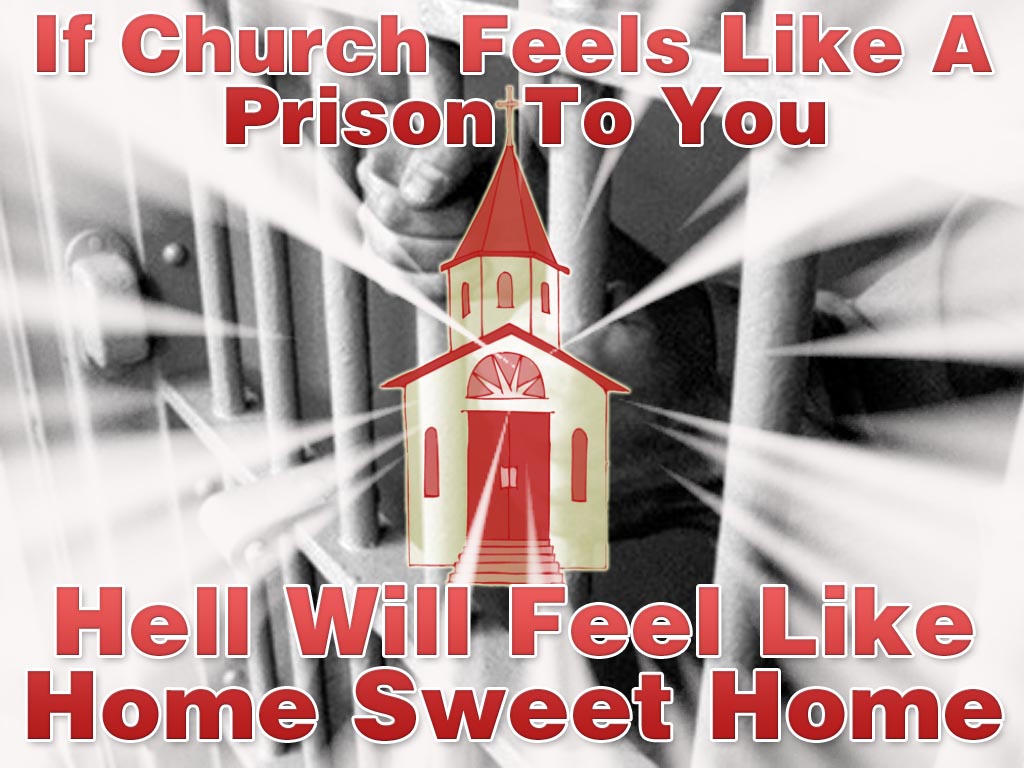
If Church Feels Like A Prison To You by Alfred Shannon Jr.

https://biblicalproof.wordpress.com/2011/05/page/3/


If one spends their entire life kicking and screaming to stay away from God’s Word, God’s people, and God’s Church, it is only fitting that they also depart from God for an eternity. We do reap what we sow.
Hos 8:7; Job 4:8; Prov 22:8; 2 Thess 2:10; 1 Jn 4:20; 1 Cor. 11:22; Mt 7:23; Gal 6:7

FIRST JOHN by Paul Southern

http://www.oldpaths.com/Archive/Southern/Paul/1901/john1.html

FIRST JOHN

  1. THE TITLE
  2. This letter bears the name of the writer, and is the first of three general epistles by John.
  3. THE WRITER
  4. The writer nowhere indicates his name, but the uniform testimony of the early church affirmed that John the apostle was the writer. There is also a close similarity of thought and expression between the Gospel according to John and the epistle. John was the son of Zebedee and Salome, and brother of James. James and John were "surnamed Boanerges, which is, the sons of thunder" (Mk 3:17). Peter, James and John were the Lord's closest friends, but John held the distinction of being the disciple whom Jesus loved (Jn 19:26). John was an eyewitness of the person and labors of the Lord (I Jn 1:1-4; 4:14).
  5. THE ONES ADDRESSED
  6. We cannot be sure about the destination of this epistle, but it was probably written primarily to the churches in and around Asia Minor, for a large part of John's life was spent at Ephesus. They were of all ages of Christian development, hated of the world, inclined to worldliness, and in danger of being led into doubt by some who denied the divinity of Christ.
  7. TIME AND PLACE OF WRITING
  8. The letter was probably written from Ephesus, but the precise dates are uncertain. The dates suggested range from A.D. 69 to A.D. 100, however most writers fix the time around A.D. 90-95.
  9. OCCASION FOR THE EPISTLE
  10. The purpose of the letter was to warn against prevailing errors, and tell the disciples how to be sure to gain eternal life (5:13). One group of false teachers among the brethren questioned the divinity of our Lord (2:18-22; 4:15; 5:1). Others denied His humanity, and thus taught that His incarnation was but a myth (Heb 2:14-18; 4:15; I Jn 1:1-3; 4:3;5:6). There was a third group who taught that one could worship God with the spirit and indulge in every sin with the body. John refutes this creed by showing that every sin is transgression (2:3-6; 3:4, 8-10; 4:13; 5:16-17). Errors reflected in this epistle crystallized into a philosophy that became known as Gnosticism. It gave pure Christianity a terrific struggle during the second century. Cerinthians, Ebionites and Docetists threatened to undermine the gospel.
  11. STYLE OF WRITING
  12. The material resembles a sermon more than an epistle. Although the thought is profound, the language is simple. The book contains many contrasts, parallelisms and repetitions. It reveals the writer to be both affectionate and severe, as all true disciples should be. The gentlest Christian may be a son of thunder (Mk 3:17).
  13. THE THEME
  14. The central theme of this epistle is fellowship with God through Jesus Christ His Son.

  15. ANALYSIS

    1. Introduction (1:1-4).
    2. God's light (1:5-2:28). To have fellowship with God we must walk in His light.
    3. God's righteousness (2:29-4:6). Fellowship with God depends upon our doing righteousness.
    4. God's love (4:7-5:3). Fellowship with God depends upon our having love and manifesting its spirit.
    5. God's faithfulness (5:4-12). We cannot have fellowship with God without faith in Him.
    6. Conclusion (5:13-21).

  16. EXERCISES FOR STUDENT ACTIVITY

    1. Summarize the teaching of I John concerning sin.
    2. Learn what the epistle teaches regarding: life, light, fellowship, propitiation, antichrist, anointing, fear, murder and the world.
    3. "Love or Perish" is a popular prescription in modern psychotherapy. What does I John teach on the subject?
    4. Discuss the statement, "Whosoever abideth in him sinneth not" (I John 3:6).
    5. Prepare a brief paper on Gnosticism as it is outlined in encyclopedias.

Published in The Old Paths Archive
(http://www.oldpaths.com)

From creation to disobedience and back again by Gary Rose


I woke up early today, even before the sun had risen and lay in bed for awhile, thinking of some of my fellow Christians and praying for their well being. Then for some reason I thought of my Composite Bible Small version and a technical problem I had running it on my "new" (refurbished) computer with Windows 7 on it. 

Then I remembered that I had originally made CBS using The Windows Vista operating system and that accounted for the problem.

As I continued in thought, I remembered the icon for the program (above) and associated the sky with all nature. And, in like manner I naturally thought of God's creation and of the first few chapters in Genesis.

When I sat down to do my blog, I looked at those chapters and began to consider them again. Here are the passages and then some of my own thoughts...


Genesis 1 (World English Bible)

1 In the beginning, God created the heavens and the earth.  2 The earth was formless and empty. Darkness was on the surface of the deep and God’s Spirit was hovering over the surface of the waters. 

  3  God said, “Let there be light,” and there was light.  4 God saw the light, and saw that it was good. God divided the light from the darkness.  5 God called the light “day”, and the darkness he called “night”. There was evening and there was morning, the first day. 

  6  God said, “Let there be an expanse in the middle of the waters, and let it divide the waters from the waters.”  7 God made the expanse, and divided the waters which were under the expanse from the waters which were above the expanse; and it was so.  8 God called the expanse “sky”. There was evening and there was morning, a second day. 

  9  God said, “Let the waters under the sky be gathered together to one place, and let the dry land appear”; and it was so.  10 God called the dry land “earth”, and the gathering together of the waters he called “seas”. God saw that it was good.  11 God said, “Let the earth yield grass, herbs yielding seeds, and fruit trees bearing fruit after their kind, with their seeds in it, on the earth”; and it was so.  12 The earth yielded grass, herbs yielding seed after their kind, and trees bearing fruit, with their seeds in it, after their kind; and God saw that it was good.  13 There was evening and there was morning, a third day. 

  14  God said, “Let there be lights in the expanse of sky to divide the day from the night; and let them be for signs to mark seasons, days, and years;  15 and let them be for lights in the expanse of sky to give light on the earth”; and it was so.  16 God made the two great lights: the greater light to rule the day, and the lesser light to rule the night. He also made the stars. 17 God set them in the expanse of sky to give light to the earth,  18 and to rule over the day and over the night, and to divide the light from the darkness. God saw that it was good.  19 There was evening and there was morning, a fourth day. 

  20  God said, “Let the waters abound with living creatures, and let birds fly above the earth in the open expanse of sky.”  21 God created the large sea creatures and every living creature that moves, with which the waters swarmed, after their kind, and every winged bird after its kind. God saw that it was good.  22 God blessed them, saying, “Be fruitful, and multiply, and fill the waters in the seas, and let birds multiply on the earth.”  23 There was evening and there was morning, a fifth day. 

  24  God said, “Let the earth produce living creatures after their kind, livestock, creeping things, and animals of the earth after their kind”; and it was so.  25 God made the animals of the earth after their kind, and the livestock after their kind, and everything that creeps on the ground after its kind. God saw that it was good. 

  26  God said, “Let us make man in our image, after our likeness: and let them have dominion over the fish of the sea, and over the birds of the sky, and over the livestock, and over all the earth, and over every creeping thing that creeps on the earth.”  27 God created man in his own image. In God’s image he created him; male and female he created them. (emphasis added) 28 God blessed them. God said to them, “Be fruitful, multiply, fill the earth, and subdue it. Have dominion over the fish of the sea, over the birds of the sky, and over every living thing that moves on the earth.”  29 God said, “Behold, I have given you every herb yielding seed, which is on the surface of all the earth, and every tree, which bears fruit yielding seed. It will be your food. 30 To every animal of the earth, and to every bird of the sky, and to everything that creeps on the earth, in which there is life, I have given every green herb for food;” and it was so. 

  31  God saw everything that he had made, and, behold, it was very good.  (emphasis added) There was evening and there was morning, a sixth day. 


Genesis 3 (WEB)

  4  The serpent said to the woman, “You won’t surely die,  5 for God knows that in the day you eat it, your eyes will be opened, and you will be like God, knowing good and evil.” 

  6  When the woman saw that the tree was good for food, and that it was a delight to the eyes, and that the tree was to be desired to make one wise, she took some of its fruit, and ate; and she gave some to her husband with her, and he ate it, too.  7 Their eyes were opened, and they both knew that they were naked. They sewed fig leaves together, and made coverings for themselves.  8 They heard the voice of Yahweh God walking in the garden in the cool of the day, and the man and his wife hid themselves from the presence of Yahweh God among the trees of the garden. 

  9  Yahweh God called to the man, and said to him, “Where are you?” 

  10  The man said, “I heard your voice in the garden, and I was afraid, because I was naked; and I hid myself.” 

  11  God said, “Who told you that you were naked? Have you eaten from the tree that I commanded you not to eat from?” 

  12  The man said, “The woman whom you gave to be with me, she gave me fruit from the tree, and I ate it.” 


 22  Yahweh God said, “Behold, the man has become like one of us, knowing good and evil. Now, lest he reach out his hand, and also take of the tree of life, and eat, and live forever...” 23 Therefore Yahweh God sent him out from the garden of Eden, to till the ground from which he was taken. (emphasis added)


Why in the world did this sin take place? Adam and Eve were beings made in the likeness and image of God. They were innocent humans, living in a perfect place. They obviously had fellowship with God Gen 3:8. God had spoken to them (3:11), giving them them instructions (commandment[s]) what to do. It seems obvious to me that they knew who God was and what HE had done (creation). Again, why did they disobey and with it, sin?

They were tricked by the serpent is my first response, but I think there was more to it than just that. Why were they even able to be tricked in the first place, for, after all, weren't they made in the image and likeness of God? Further, both Adam and Eve were part of God's proclamation in Genesis 1:31- "very good"?

Yes, they were made like God. However, there was one difference- they didn't know about good and evil. They were innocent and easily tricked. Perhaps (conjecture on my part) they didn't even know there would be consequences for disobedience.

The next time you look up to the heavens and see a beautiful blue sky with seemingly perfect clouds in it, think of Adam and Eve in that perfect Garden of Eden and remember the creator. Then purpose in your heart to obey HIM in all things that HE COMMANDS YOU TO DO! Then obey willingly!!!

Problem solved!!!