10/28/19

Is There a "Missing Quote" in the book of James? by AP Staff


Is There a "Missing Quote" in the book of James?

by AP Staff


Q.

I have heard it stated that in the New Testament book of James, the writer referred to a quotation from the Old Testament that actually does not exist. Is there a “missing quote” from the O.T. to which James was referring?

A.

In addressing the passage found in James 4:5 (to which this particular question refers), Albert Barnes wrote in his commentary: “Few passages of the New Testament have given expositors more perplexity than this” (1972, p. 70). Those hostile to Christianity often try to find anything they can to discredit the Bible. The slightest “discrepancy” or “contradiction” is considered as solid proof that the Bible is inaccurate and therefore unreliable. The passage in James 4:5 is one such instance where skeptics and infidels have taken a verse and tried to use it to discredit the Scriptures. In context, the passage reads as follows (the highlighted section is the particular portion in question):
Ye adulterers and adulteresses, know ye not that the friendship of the world is enmity with God? Whosoever therefore will be a friend of the world is the enemy of God. Do ye think that the scripture saith in vain, The spirit that dwelleth in us lusteth to envy? But he giveth more grace. Wherefore he saith, God resisteth the proud, but giveth grace unto the humble. Submit yourselves therefore to God. Resist the devil, and he will flee from you (James 4:4-7, KJV).
Unfaithful creatures! Do you not know that friendship with the world is enmity with God? Therefore, whoever wishes to be a friend of the world makes himself an enemy of God. Or do you suppose it is in vain that the scripture says, “He yearns jealously over the spirit which he has made to dwell in us”? But he gives more grace; therefore it says, “God opposes the proud, but gives grace to the humble.” Submit yourselves therefore to God. Resist the devil and he will flee from you (James 4:4-7, RSV).
The KJV and RSV separate verse five into two sections. The first introduces a supposed quote with the phrase “the scripture says,” and draws attention to the second section, which seems to highlight the quotation either via quotation marks (as in the RSV) or by capitalizing the first word of the quote (as in the KJV). According to those attempting to discredit the Bible, this verse “proves” that the Bible is false since the supposed quotation is found nowhere in Scripture. If it were true that there is a missing quote in the Bible, then some would perceive it as bringing into doubt the validity of the book of James. If the Bible is legitimately called into question, then Christianity’s foundation crumbles. Thus, there is a need to answer such charges brought against the Word of God.
With some careful study, one finds that the controversy can be explained fairly simply. When James’ comment is considered in its context, and is translated correctly, it becomes apparent that he did not intend for the second half of the verse to be taken as a direct quotation from the Old Testament. The translations provided by the King James Version, Revised Standard Version, and others that render the verse as a quotation, are incorrect. [It is important to realize that the manuscripts with which translators work contain little or no punctuation. Thus, the translators must exercise some discretion when implementing punctuation marks in the text.]
Such a suggestion raises the question as to what the correct translation is for the passage. Several solutions have been presented, the most likely of which being that James did not intend to quote a specific verse, but instead was referring to ideas and concepts found throughout the whole of the Old Testament. In his commentary on the books of Hebrews and James, R.C.H. Lenski wrote:
Many pages have been written regarding the different interpretations of v. 5 and the discussions of these interpretations. We confine ourselves to two points. We are not convinced that the question is a formula of quotation. Such a formula has never been used: “Do you think that the Scripture speaks in an empty way?” If a quotation were to follow, we should certainly expect the addition “saying that.”
What follows has never been verified as being a quotation; nothing like it has been found in any writing as all admit. The fact that the Scripture does not speak in an empty way refers to v. 4 which presents as a teaching of Scripture the truth that friendship of the world is enmity against God, etc. The idea is not that this is a quotation, but that it is a teaching of Scripture and by no means empty (1966, p. 631, emp. in orig.).
The late Bible scholar, Guy N. Woods, supported the idea of James’ reference being, not to a specific quote, but rather to a general concept within the Old Testament writings. He cited Genesis 6:3-7, Exodus 29:5, Deuteronomy 32:1-21, Job 5:12, Ecclesiastes 4:4, and Proverbs 27:4 as verses where the thought behind James 4:5 is conveyed (1972, p. 214). Several commentators believe that James’ statement represents a “condensation” of the Old Testament rather than an exact quotation—a position that fits the context of the verse, and solves the problem of the “missing quote.”
James Coffman offered another possibility along the same line. He suggested that the verse is referring to the New Testament writings, particularly those of Paul, instead of those from the Old Testament (1984, p. 87). However, it appears highly unlikely that, as Coffman maintains, James’ comment refers to the Pauline epistles, since New Testament Scripture is referenced only twice in the New Testament—once where Paul (in 1 Timothy 5:18) quotes the words of Christ as written by Luke in Luke 10:7, and once where Peter (in 2 Peter 3:15-16) mentions as a whole the writings of Paul. The remainder of the citations in the New Testament come from the Old Testament, except for a quote from an Athenian poet in Acts 17:28, from Epimenides in Titus 1:12, and possibly from a now-lost hymn or poem in Ephesians 5:14.
Whether it is a reference to Old or New Testament concepts, the KJV and RSV both have done an inadequate job of translating the verse. The late, respected Greek scholar J.W. Roberts was correct in saying that the 1901 American Standard Version provides the closest match to the true meaning (1977, p. 129).
Ye adulteresses, know ye not that the friendship of the world is enmity with God? Whosoever therefore would be a friend of the world maketh himself an enemy of God. Or think ye that the scripture speaketh in vain? Doth the spirit which he made to dwell in us long unto envying? But he giveth more grace. Wherefore the scripture saith, God resisteth the proud, but giveth grace to the humble. Be subject therefore unto God; but resist the devil, and he will flee from you (James 4:4-7, ASV, emp. added).
Hugo McCord, in his independent translation of the New Testament, rendered James 4:5 very much like the American Standard Version, with a slight updating of language. His translation reads: “Do you think that the scripture speaks emptily? Does the Spirit living in us lust to envy?” (1988, p. 442).
Regardless of which version is used, it appears that James did not intend this verse to be taken as a quotation. The most likely answer is that James did indeed refer to ideas and thoughts expressed throughout the entire Old Testament, rather than quoting a specific verse.

REFERENCES

Barnes, Albert (1972 reprint), Barnes’ Notes—James, Peter, John, and Jude (Grand Rapids, MI: Baker).
Coffman, James Burton (1984), Commentary on James, 1 & 2 Peter, 1, 2 & 3 John, Jude (Abilene, TX: ACU Press).
Lenski, R.C.H. (1966), The Interpretation of the Epistle to the Hebrews and of the Epistle of James (Minneapolis, MN: Augsburg).
McCord, Hugo (1988), McCord’s New Testament Translation of the Everlasting Gospel (Henderson, TN: Freed-Hardeman College).
Roberts, J.W. (1977), The Letter of James (Austin, TX: Sweet).
Woods, Guy N. (1972), A Commentary on the Epistle of James (Nashville, TN: Gospel Advocate).

Is the New Testament a Product of the Church? by Eric Lyons, M.Min.


Is the New Testament a Product of the Church?

by Eric Lyons, M.Min.


Sometimes Christians forget that when the church of Christ was first established on Pentecost, it did not possess the New Testament as we have it today. The church’s “Bible” was the Old Testament. It had been completed about 425 B.C., and was the Bible Jesus and others often quoted in their teachings. The church’s new teachings were based on the authority Christ gave the apostles (John 14:26; 16:13). Inspired men soon put in writing new divine regulations (cf. 1 Corinthians 14:35) that were collected and read regularly in the assemblies not long after they were written. The New Testament canon gradually took shape so that within roughly 150 years of Pentecost, the New Testament books already had been collected. [NOTE: Near the middle of the second century, Justin Martyr wrote that on Sundays in the Christian worship “memoirs of the apostles” were read together with “writings of the prophets” (The First Apology, 67).]
Sometimes people claim that “the New Testament is simply a product of church.” Such a statement usually is made in order to imply that the Bible is merely a product of the early church councils that met to discuss which books should be included in the New Testament canon. Critics thus belittle the idea that the New Testament we have today actually originated with God.
How does one respond to the question, “Is the New Testament a product of the church?” First, a book’s authenticity depended upon its authority (i.e., did it come from God?), and when it was accepted as canonical, it was accepted because of its inherent authority. The 27 books of the New Testament made their way into the Bible much like the books of the Old Testament. Books were included because: (a) they were known to have come from God—i.e., they contained the commandments of God; (b) they were written by an apostle or prophet of God—like Peter or Paul who could perform miracles to confirm what they were teaching; (c) they could be proven to be genuine—such as the book of Luke, written by Luke; and (d) they were used by Christians.
Second, church councils could not make the books of the Bible authoritative. The books either were inherently authoritative or they were not. Consider the 13-month-old boy who calls his father “daddy” for the first time. Is that the very moment when the man actually becomes his father, or was this man his daddy long before the child started calling him such? The fact is, this man was the father when the child was conceived; he was his father when the baby was born; and he was already the father when the child first called him daddy. Just because he never had called the man his daddy until he was 13 months old does not mean he was not already his father. Similarly, just because hundreds of years ago certain groups of men held meetings to decide which books they thought belonged in the Bible, does not mean that they produced the Bible. These men no more gave us the 27 books of the New Testament than Sir Isaac Newton gave us the force of gravity. God gave us gravity via His work of creation; similarly, He gave us the New Testament canon by inspiring the individual books that compose it. Newton did not create gravity, but he did recognize it. Likewise, early church councils did not produce the New Testament; rather, they simply recognized which books God had inspired. Thus, God wrote the books of the Bible; men simply put them together.

Who are the churches of Christ and what do they believe? By: Batsell Barrett Baxter


What is the distinctive plea of the church of Christ?

It is primarily a plea for religious unity based upon the Bible. In a divided religious world it is believed that the Bible is the only possible common denominator upon which most, if not all, of the God-fearing people of the land can unite. This is an appeal to go back to the Bible. It is a plea to speak where the Bible speak and to remain silent where the Bible is silent in all matters that pertain to religion. It further emphasizes that in everything religious there must be a "Thus saith the Lord" for all that is done. The objective is religious unity of all believers in Christ. The basis is the New Testament. The method is the restoration of New Testament Christianity.
The Historical background of the Restoration Movement.

One of the earliest advocates of the return to New Testament Christianity, as a means of achieving unity of all believers in Christ, was James O'Kelly of the Methodist Episcopal Church. In 1793 he withdrew from the Baltimore conference of his church and called upon others to join him in taking the Bible as the only creed. His influence was largely felt in Virginia and North Carolina where history records that some seven thousand communicants followed his leadership toward a return to primitive New Testament Christianity.

In 1802 a similar movement among the Baptists in New England was led by Abner Jones and Elias Smith. They were concerned about "denominational names and creeds" and decided to wear only the name Christian, taking Bible as their only guide. In 1804, in the western frontier state of Kentucky, Barton W. Stone and several other Presbyterian preachers took similar action declaring that they would take the Bible as the "only sure guide to heaven." Thomas Campbell, and his illustrious son, Alexander Campbell, took similar steps in the year 1809 in what is now the state of West Virginia. They contended that nothing should be bound upon Christians as a matter of doctrine which is not as old as the New Testament. Although these four movements were completely independent in their beginnings eventually they became one strong restoration movement because of their common purpose and plea. These men did not advocate the starting of a new church, but rather a return to Christ's church as described in the Bible.

Members of the church of Christ do not conceive of themselves as a new church started near the beginning of the 19th century. Rather, the whole movement is designed to reproduce in contemporary times the church originally established on Pentecost, A.D. 30. The strength of the appeal lies in the restoration of Christ's original church.

How many churches of Christ are there?

The most recent dependable estimate lists more than 15,000 individual churches of Christ. The "Christian Herald," a general religious publication which presents statistics concerning all the churches, estimates that the total membership of the churches of Christ is now 2,000,000. There are more than 7000 men who preach publicly. Membership of the church is heaviest in the southern states of the United States, particularly Tennessee and Texas, though congregations exist in each of the fifty states and in more than eighty foreign countries. Missionary expansion has been most extensive since the second World War in Europe, Asia and Africa. More than 450 full time workers are supported in foreign countries. The churches of Christ now have five times as many members as were reported in the U.S. Religious Census of 1936.

How are the churches organizationally connected?

Following the plan of organization found in the New Testament, churches of Christ are autonomous. Their common faith in the Bible and adherence to its teachings are the chief ties which bind them together. There is no central headquarters of the church and no organization superior to the elders of each local congregation. Congregations do cooperate voluntarily in supporting the orphans and the aged, in preaching the gospel in new fields, and in other similar works.

Members of the church of Christ conduct forty colleges and secondary schools, as well as seventy-five orphanages and homes for the aged. There are approximately 40 magazines and other periodicals published by individual members of the church. A nationwide radio and television program, known as "The Herald of Truth" is sponsored by the Highland Avenue church in Abilene, Texas. Much of its annual budget of $1,200,000 is contributed on a free-will basis by other churches of Christ. The radio program is currently heard on more than 800 radio stations, while the television program is now appearing on more than 150 stations. Another extensive radio effort known as "World Radio" owns a network of 28 stations in Brazil alone, and is operating effectively in the United States and a number of other foreign countries, and is being produced in 14 languages. An extensive advertising program in leading national magazines began in November 1955.

There are no conventions, annual meetings, or official publications. The "tie that binds" is a common loyalty to the principles of the restoration of New Testament Christianity.

How are the churches of Christ governed?

In each congregation, which has existed long enough to become fully organized, there is a plurality of elders or presbyters who serve as the governing body. These men are selected by the local congregations on the basis of qualifications set down in the scriptures (1 Timothy 3:1-8). Serving under the elders are deacons, teachers, and evangelists or ministers. The latter do not have the authority equal to or superior to the elders. The elders are shepherds or overseers who serve under the headship of Christ according to the New Testament, which is a kind of constitution. There is no earthly authority superior to the elders of the local church.

What does the church of Christ believe about the Bible?

The original autographs of the sixty six books which make up the Bible are considered to have been divinely inspired, by which it is meant that they are infallible and authoritative. Reference to the scriptures is made in settling every religious question. A pronouncement from the scripture is considered the final word. The basic textbook of the church and the basis for all preaching is the Bible.

Do members of the churches of Christ believe in the virgin birth?

Yes. The statement in Isaiah 7:14 is taken as a prophecy of the virgin birth of Christ. New Testament passages such as Matthew 1:20, 25, are accepted at face value as declarations of the virgin birth. Christ is accepted as the only begotten Son of God, uniting in his person perfect divinity and perfect manhood.

Does the church of Christ believe in predestination?

Only in the sense that God predestines the righteous to be eternally saved and the unrighteous to be eternally lost. The statement of the apostle Peter, "Of a truth I perceive that God is no respecter of persons, but in every nation he that feareth him and worketh righteousness is acceptable unto him"(Acts 10:34-35.) is taken as an evidence that God did not predestine individuals to be eternally saved or lost, but that each man determines his own destiny.

Why does the church of Christ baptize only by immersion?

The word baptize comes from the Greek word "baptizo" and literally means, "to dip, to immerse, to plunge." In addition to the literal meaning of the word, immersion is practiced because it was the practice of the church in apostolic times. Still further, only immersion conforms to the description of baptisms as given by the apostle Paul in Romans 6:3-5 where he speaks of it as a burial and resurrection.

Is infant baptism practiced?

No. Only those who have reached the "age of accountability" are accepted for baptisms. It is pointed out that the examples given in the New Testament are always of those who have heard the gospel preached and have believed it. Faith must always precede baptism, so only those old enough to understand and believe the gospel are considered fit subjects for baptism.

Do ministers of the church hear confession?

No. Ministers or evangelists of the church have no special prerogatives. They do not wear the title of Reverend or Father, but are addressed simply by the term Brother as are all other men of the church. Along with elders and others they do counsel and advise those seeking help.

Are prayers addressed to the saints?

No. God the Father is considered the only one to whom the prayers may be addressed. It is further understood that Christ stands in a mediatorial position between God and man (Hebrews 7:25). All prayers are therefore offered through Christ, or in the name of Christ (John 16:23-26).

How often is the Lord's supper eaten?

It is expected that every member of the church will assemble for worship on each Lord's day. A central part of the worship is the eating of the Lord's supper (Acts 20:7). Unless providentially hindered, each member considers this weekly appointment as binding. In many instances, as in the case of illness, the Lord's supper is carried to those who are hindered from attending the worship.

What kind of music is used in the worship?

As a result of the distinctive plea of the church - a return to New Testament Faith and practice - acapella singing is the only music used in the worship. This singing, unaccompanied by mechanical instruments of music, conforms to the music used in the apostolic church and for several centuries thereafter (Ephesians 5:19). It is felt that there is no authority for engaging in acts of worship not found in the New Testament. This principle eliminates the use of instrumental music, along with the use of candles, incense, and other similar elements.

Does the church of Christ believe in heaven and hell?

Yes. The statement of Christ in Matthew 25, and elsewhere, are taken at face value. It is believed that after death each man must come before God in judgement and that he will be judged according to the deeds done while he lived (Hebrews 9:27). After judgement is pronounced he will spend eternity either in heaven or hell.

Does the church of Christ believe in purgatory?

No. The absence of any reference in the scriptures to the temporary place of punishment from which the soul will eventually be released into heaven prevents the acceptance of the doctrine of purgatory.

By what means does the church secure financial support?

Each first day of the week the members of the church "lay by in store as they have been prospered" (1 Corinthians 16:2). The amount of any individual gift is generally known only to the one who gave it and to the Lord. This free-will offering is the only call which the church makes. NO assessments or other levies are made. No money-making activities, such as bazaars or suppers, are engaged in. A total of approximately $200,000,000 is given on this basis each year.

Does the church of Christ have a creed?

No. At least, there is no creed in the usual sense of the word. The belief of the church is stated fully and completely in the Bible. There is no other manual or discipline to which the members of the church of Christ give their allegiance. The Bible is considered as the only infallible guide to heaven.

How does one become a member of the church of Christ?

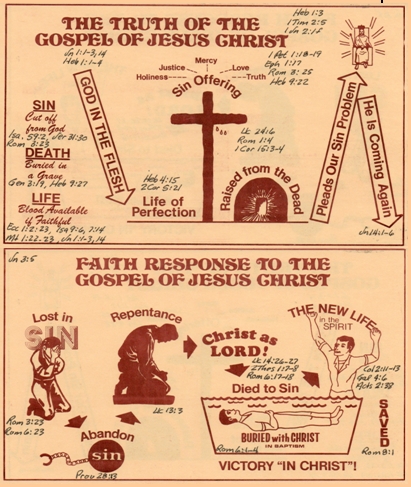
In the salvation of man's soul there are 2 necessary parts: God's part and man's part. God's part is the big part, "For by grace you have been saved through faith, and that not of yourselves, it is the gift if God; not of works, that no man should glory" (Ephesians 2:8-9). The love which God felt for man led him to send Christ into the world to redeem man. The life and teaching of Jesus, the sacrifice on the cross, and the proclaiming of the gospel to men constitute God's part in salvation.

Though God's part is the big part, man's part is also necessary if man is to reach heaven. Man must comply with the conditions of pardon which the Lord has announced. Man's part can clearly set forth in the following steps:

  • Hear the Gospel. "How shall they call on him whom they have not believed? and how shall they believe him whom they have not heard? and how shall they hear without a preacher?"(Romans 10:14).
  • Believe. "And without faith it is impossible to be wellpleasing unto him; for he that cometh to God must believe that he is, and that he is a rewarder of them that seek after him" (Hebrews 11:6).
  • Repent of past sins. "The times of ignorance therefore God overlooked; but now he commandeth men that they should all everywhere repent."(Acts 17:30).
  • Confess Jesus as Lord. "Behold here is water; What doth hinder me to be baptized ? And Philip said, if thou believeth with all thy heart thou mayest. And he answered and said, I believe that Jesus Christ is the Son of God" (Acts 8:36-37).
  • Be baptized for the remission of sins. "And Peter said unto them, Repent ye, and be baptized everyone of you in the name of Jesus Christ unto the remission of your sins and ye shall receive the gift of the Holy Spirit."(Acts 2:38).
  • Live a Christian life. "Ye are an elect race, a royal priesthood, a holy nation, a people for God's own possession, that ye may show forth the excellencies of him who called you out of darkness into his marvelous light" (1 Peter 2:9).
CLICK ON ABOVE GRAPHIC TO DOWNLOAD
OPEN INVITATION

Now that you are aware of a church in the 21st century which is built according to the blue prints of Christ's original church, why not become a member of it? In becoming a member of it, you will be called upon to do nothing which you cannot read in the New Testament. You will then live and worship just as the apostle-guided Christians of the first century did.

Not only is this return to New Testament Christianity a wonderful basis upon which all believers in Christ can unite, it is absolutely solid ground. If we do just what our Lord commanded we know that our salvation is certain. Come with us as we go back to the Bible, back to Christ and his church.

THE ASSUMPTION OF THE VIRGIN MARY? BY STEVE FINNELL


THE ASSUMPTION OF THE VIRGIN MARY?  BY STEVE FINNELL


The Catholic Church teaches the assumption, that is that the body of the Virgin Mary was resurrected and went to heaven.

Today, the belief in the corporeal assumption of Mary is universal in East and in the West; according to Benedict XIV (De Festis B.V.M., I, viii,18) it is a  probable opinion, which to deny were impious and blasphemous. [Ref.Catholic Encyclopedia]

The problem with the assumption of Mary is that only Jesus Christ has ascended into heaven. John 3:13 No one has ascended into heaven, but He who descended from heaven:the Son of Man.(NASB)

Not even David has ascended into heaven. Acts 2:34 For it was not David who ascended into heaven...(NASB)  Why would anyone believe that Mary has been resurrected and bodily ascended into heaven?

At death man's spirit returns to God, however, his body turns to dust and remains there until the resurrection. (Ecclesiastes 12:1-7)

There has been nor will there be anyone bodily resurrections until Jesus returns.

 1 Thessalonians 4:15-16 For this we say to you by the word of the Lord, that we who are alive and remain until the coming of the Lord, will not precede those who have fallen asleep. 16 For the Lord Himself will descend from heaven with a shout, with the voice of the archangel and with the trumpet of God, and the dead in Christ will arise first.(NASB)

The bodies of all the dead in Christ are still in their graves.

The bodily assumption of the Virgin Mary is not only improbable, it is impossible. 

1 Corinthians 15:50-58 Now I say this, brethren, that flesh and blood cannot inherit the kingdom of God................(NASB)    

“Jesus Christ is the same, yesterday, today, and forever” (Hebrews 13:8). What unseen things are eternal? by Roy Davison


“Jesus Christ is the same, yesterday, today, and forever”
(Hebrews 13:8).

What unseen things are eternal?


“We do not look at the things which are seen, but at the things which are not seen. For the things which are seen are temporary, but the things which are not seen are eternal” (2 Corinthians 4:18).
There is a physical realm and a spiritual realm. The physical realm is finite. The universe had a beginning and will have an end. The spiritual realm is infinite.
Science deals with the physical realm. Philosophy and religion deal with the spiritual realm.
Philosophically, if something exists now, something must have always existed. According to scientific observations, the physical realm has not always existed. Thus, it must be something spiritual that has always existed.
Intelligence is the most exalted phenomenon we observe. The intelligence of one person is more amazing than all the physical things of the universe combined. Thus to conclude that an intelligent, Spiritual Being has always existed, is logical and consistent with scientific observations and philosophical principles.
Paul's statement that “the things which are seen are temporary, but the things which are not seen are eternal” (2 Corinthians 4:18) is scientifically and philosophically sound.
What unseen things are eternal? First, and foremost:

God is eternal.

Moses was raised by Pharaoh's daughter and had access to all the wealth of Egypt. Yet, beyond the vanity of visible things, he saw the Unseen God: “By faith Moses, when he became of age, refused to be called the son of Pharaoh's daughter, choosing rather to suffer affliction with the people of God than to enjoy the passing pleasures of sin, esteeming the reproach of Christ greater riches than the treasures in Egypt; for he looked to the reward. By faith he forsook Egypt, not fearing the wrath of the king; for he endured as seeing Him who is invisible” (Hebrews 11:24-27).
How could Moses 'see' the unseen God? The same way all men and women of faith are conscious of God's presence. God has made Himself known. Paul explains: “What may be known of God is manifest in them, for God has shown it to them. For since the creation of the world His invisible attributes are clearly seen, being understood by the things that are made, even His eternal power and Godhead, so that they are without excuse, because, although they knew God, they did not glorify Him as God, nor were thankful” (Romans 1:19-21).
The story is told of an atheist who sneeringly asked a little girl if she believed in God. When she replied that she did, he said: “I'll give you a euro if you can show me where God is.” She replied, “Sir, I'll give you 5 euros if you can show me where God isn't!”
“Holy, holy, holy is the Lord of hosts; the whole earth is full of His glory!” (Isaiah 6:3).

God is self-existent, He always has existed and always shall exist.

When God told Moses to rescue His people from Egypt, Moses asked: “When I come to the children of Israel and say to them, 'The God of your fathers has sent me to you,' and they say to me, 'What is His name?' what shall I say to them? And God said to Moses, 'I AM WHO I AM.' And He said, 'Thus you shall say to the children of Israel, “I AM has sent me to you”'” (Exodus 3:13, 14).
The one true God does not need a proper name to distinguish Him from other gods. He is God. He is the Lord. He is 'I AM', Infinite Being.
Among the people of Israel this became a sacred designation for God. The Hebrew word, sometimes transliterated as Jehovah or Jaweh, is called the Tetragrammaton because it consists of four consonants. Ancient written Hebrew did not include vowels. The vowels had to be inserted mentally when the text was read. Thus, many written words could have different meanings depending on which vowels were added.
I once asked a rabbi why Jews do not pronounce the Tetragrammaton. His explanation was that the written word could mean 'I am', 'I was' and 'I shall be' depending on the vowels added. Thus, to pronounce the word would limit its meaning.
This designation for God appears more than 6000 times in the Old Testament. When the text was read aloud, however, the word for 'Lord' was read. Inspired by the Holy Spirit, the New Testament writers used the Greek word for 'Lord' to translate Old Testament quotations containing the Tetragrammaton except in a few instances where the Greek word for 'God' appears.

Jesus is I AM.

When the writer of Hebrews says: “Jesus Christ is the same, yesterday, today, and forever” (Hebrews 13:8), he is ascribing this trait to Christ.
That Jesus is the same, relates to what is said of God in the Psalms: “Of old You laid the foundation of the earth, and the heavens are the work of Your hands. They will perish, but You will endure; yes, they will all grow old like a garment; like a cloak You will change them, and they will be changed. But You are the same, and Your years will have no end” (Psalm 102:25-27).
This Psalm is addressed to God (verse 24). The designation 'Jehovah' is used seven times (in verses 1, 12, 15, 16, 18, 19 and 22). God does not change. With the “Father of lights” “there is no variation or shadow of turning” (James 1:16). “For I am the Lord, I do not change” (Malachi 3:6).
In Hebrews 13 it says that Jesus Christ is always the same. In Hebrews, chapter 1, Psalm 102 is applied to Christ (preceded by Psalm 45:6, 7).
“But to the Son He says:
'Your throne, O God, is forever and ever;

A scepter of righteousness is the scepter of Your kingdom.
You have loved righteousness and hated lawlessness;
Therefore God, Your God, has anointed You
With the oil of gladness more than Your companions.'
And:
'You, Lord, in the beginning laid the foundation of the earth,

And the heavens are the work of Your hands.
They will perish, but You remain;
And they will all grow old like a garment;
Like a cloak You will fold them up,
And they will be changed.
But You are the same,
And Your years will not fail'” 
(Hebrews 1:8-12).

This text proclaims the deity, eternity and changelessness of Christ.
The immutability of Christ is contrasted with the continually changing universe that will pass away. Jesus said: “Heaven and earth will pass away, but My words will by no means pass away” (Matthew 24:35).
“They will perish, but You remain. . They will be changed, but You are the same” (Psalm 102:26, 27). “Jesus Christ is the same yesterday, today, and forever” (Hebrews 13:8).
“Thus says the Lord, the King of Israel, and his Redeemer, the Lord of hosts: 'I am the First and I am the Last; besides Me there is no God” (Isaiah 44:6). The two words 'LORD' in this verse are translations of the Tetragrammaton. The I AM is the first and the last.
In Isaiah 48 the Lord says: “I am He, I am the First, I am also the Last” (Verse 12).
In the Revelation to John, Jesus says: “Do not be afraid; I am the First and the Last. I am He who lives, and was dead, and behold, I am alive forevermore” (Revelation 1:17, 18). “I am the Alpha and the Omega, the Beginning and the End, the First and the Last” (Revelation 22:13). Thus, the designation, the First and the Last (which can only apply to God, the I AM) also applies to Christ.
Jesus told the unbelieving Jews: “Most assuredly, I say to you, before Abraham was, I AM” (John 8:58). If Jesus had said 'I was' He would have only stated that He existed before Abraham. By saying “Before Abraham was, I AM” He declares Himself to be Jehovah.
“We do not look at the things which are seen, but at the things which are not seen. For the things which are seen are temporary, but the things which are not seen are eternal” (2 Corinthians 4:18).
We endure as seeing Him who is invisible.
God is eternal, He is I AM. Jesus Christ, the Son of God, is also I AM with the Father. “In the beginning was the Word, and the Word was with God, and the Word was God” (John 1:1). “Jesus Christ is the same, yesterday, today and forever” (Hebrews 13:8). “Your throne, O God, is forever and ever” (Hebrews 1:8).
“The everlasting God, the Lord, the Creator of the ends of the earth, neither faints nor is weary” (Isaiah 40:28). “Now to the King eternal, immortal, invisible, to God who alone is wise, be honor and glory forever and ever. Amen” (1 Timothy 1:17).

Roy Davison

The Scripture quotations in this article are from
The New King James Version. ©1979,1980,1982, Thomas Nelson Inc., Publishers.
Permission for reference use has been granted.


Published in The Old Paths Archive
(http://www.oldpaths.com)

Trusting in a spider's web by Gary Rose


Timeless, simply timeless. Two spider’s planning something great, trusting in their ingenuity and reasoning. They waste their time and effort, for they just don’t realize they are doomed to failure.

Sometimes, it seems to me that human beings are like that, trusting in their own intelligence and creativity, only to see the wind blow away their efforts in an instant. Think I am wrong? Well, how about margarine, remember how that was touted as THE replacement for butter; today, virtually no one uses it because we are told it is not good for you. Margarine is not the only thing, for we constantly see lawyers urging people to sue over defective products that cause damage. People know so much and understand so very little. They try to live a life without God, but that life so often ends in ruin. Things like divorce, bankruptcy and diseases caused by smoking, drinking, illegal drugs can be avoided if we just lived our lives listening to God rather than our own foolish desires. The Bible says…


Proverbs 16 ( World English Bible )
[25] There is a way which seems right to a man, but in the end it leads to death.

Job 8 ( WEB )
[11] ”Can the papyrus grow up without mire? Can the rushes grow without water? [12] While it is yet in its greenness, not cut down, it withers before any other reed. [13] So are the paths of all who forget God. The hope of the godless man shall perish, [14] Whose confidence shall break apart, Whose trust is a spider’s web.

Matthew 7 ( WEB )
[24] “Everyone therefore who hears these words of mine, and does them, I will liken him to a wise man, who built his house on a rock. [25] The rain came down, the floods came, and the winds blew, and beat on that house; and it didn’t fall, for it was founded on the rock. [26] Everyone who hears these words of mine, and doesn’t do them will be like a foolish man, who built his house on the sand. [27] The rain came down, the floods came, and the winds blew, and beat on that house; and it fell—and great was its fall.”

But, you say, look at that man – he is prosperous and healthy; he doesn’t need God. Really; do you actually think that he will live forever? Ultimately, we all die- of something. Why not learn to think about more than just what you can understand by just using your senses? There really is more to life than what the human mind can comprehend. Jesus’ words of Matthew 7 make sense, for they transcend time and culture. A life lived with (and in obedience to) God is the only one that endures, because it survives beyond the grave. Think: are you trusting in a spider’s web or God? Only you can answer that question.

10/25/19

"THE BOOK OF PROVERBS" Childhood Memories Of A Wise Man (4:1-9) by Mark Copeland


"THE BOOK OF PROVERBS"

Childhood Memories Of A Wise Man (4:1-9)

INTRODUCTION

1. In Pr 1-9, we find Solomon pleading with his children to seek after
   wisdom...
   a. Through a collection of discourses
   b. Extolling and illustrating the value of wisdom time and again

2. In Pr 4:1-9, we find Solomon sharing recollections of his
   childhood...
   a. Of his own father (David)
   b. Exhorting him to seek after wisdom

[As we examine these "Childhood Memories Of A Wise Man," we will find
important principles in raising children to be godly and seekers of
wisdom.  The first memory might be stated in these words...]

I. "I WAS TAUGHT BY MY FATHER"

   A. HIS FATHER HAD ACCEPTED HIS RESPONSIBILITY...
      1. To teach him - Pr 4:3-4
      2. A responsibility placed by God on fathers - cf. Ep 6:4
      3. Not given to churches or schools per se
         a. They may serve as aids
         b. They should not become crutches
      4. For they are inadequate to teach as God intended - cf. Deut 6:
         6-9
         a. God's Word is to permeate the household
         b. Something the church and school alone cannot provide
      -- Blessed are children that have fathers who accept their
         responsibility!

   B. WHEN FATHERS FAIL TO FULFILL THEIR CHARGE...
      1. They will be held accountable
         a. Eli tried to correct his sons - 1 Sa 2:22-25
         b. But failed to his power to restrain them - 1 Sa 3:10-13
      2. The responsibility has to be taken up by others
         a. Timothy was blessed to have a godly grandmother and mother
            - 2Ti 1:5
         b. They evidently taught Timothy the Scriptures as a child
            - 2Ti 3:15
      -- Blessed are children that have mothers who provide where
         fathers do not!

[So Solomon was taught by his father, one of the greatest gifts a father
can give to a child.  But we note also the following recollection from
verse 3...]

II. "I WAS TAUGHT WHILE TENDER"

   A. THE TEACHING OCCURRED...
      1. While young enough to be impressionable
      2. Open to what the father has to say
      -- While he was willing to do what the father says

   B. TEACHING OFTEN OCCURS TOO LATE...
      1. After the child gets into trouble
      2. After the child begins to question everything parents say
      -- When a child is more likely to disregard or disobey

   C. TEACHING NEEDS TO BEGIN EARLY...
      1. Long before they are in school with other children
      2. Where peer pressure and poor behavior will encourage them to
         disobey authority
      3. Where even some teachers will encourage them to reject parental
         authority
      -- Before the child is exposed to unsavory influences

[Teaching by a father needs to occur while the child is still in a
position to be shaped and directed in the right way.  Now for another
thought we can glean from Solomon's childhood memories...]

III. "I WAS TAUGHT BY AN ANXIOUS FATHER"

   A. THE ANXIETY OF HIS FATHER IS IMPLIED...
      1. By the exhortations:  "Get wisdom! Get understanding!" - Pro
         4:5
      2. By the warnings:  "Do not forget, nor turn away...do not
         forsake" - Pr 4:5-6
      -- His father was anxious regarding his son's learning

   B. FATHERS TODAY NEED TO BE ANXIOUS...
      1. In view of what is going on in schools and society in general
         (violence, sex, drugs)
      2. In light of what is happening in many churches (apathy,
         worldliness, apostasy)
      -- Community and sometimes the church no longer provide supportive
         roles

   C. FATHERS ANXIOUS FOR THEIR CHILDREN...
      1. Will take the time to teach their children when they need it
      2. Will implore God for wisdom in raising their children
      3. Will be willing to sacrifice success and prestige in business
         to spend time with children
      -- Fathers, do we have anxiety over the welfare of our children?

[Finally, consider what Solomon's father was anxious for him to
learn...]

IV. "I WAS TAUGHT THE IMPORTANT THINGS"

   A. HE WAS TAUGHT TO VALUE WISDOM AND UNDERSTANDING...
      1. To make wisdom the principal thing in life
         a. "Get wisdom! Get understanding!" - Pr 4:5
         b. "Wisdom is the principal thing; Therefore get wisdom. And in
            all your getting, get understanding." - Pr 4:7
      2. To love, exalt, and embrace wisdom
         a. "...Love her, and she will keep you." - Pr 4:6b
         b. "Exalt her, and she will promote you..." - Pr 4:8a
         c. "...She will bring you honor, when you embrace her." - Pro
            4:8b
      3. To appreciate the benefits of wisdom
         a. "Do not forsake her, and she will preserve you..." - Pro
            4:6a
         b. "She will place on your head an ornament of grace;" - Pro
            4:9a
         c. "A crown of glory she will deliver to you." - Pr 4:9c
      -- Solomon's father wanted him to be wise above all else

   B. FATHERS OFTEN STRESS THE TRIVIAL...
      1. Too often, if a father spends any time with his children it is
         on things like:
         a. Sports
         b. Mechanics
      2. Too often, the principal concern of fathers is that their
         children get:
         a. College degrees
         b. High paying jobs
      3. Yet such things are potentially harmful!
         a. Worldly success presents many temptations
         b. Many children have been destroyed by the careers encouraged
            by their parents
      -- Without wisdom and understanding, our children will not be able
         to handle success!

CONCLUSION

1. Solomon could look back on his childhood memories with happy
   recollections...
   a. I was taught by my father
   b. I was taught while tender
   c. I was taught by an anxious father
   d. I was taught the important things

2. Because Solomon's upbringing stressed the value of wisdom...
   a. We should not be surprised of his answer when given a choice
      - 2Ch 1:7-10
   b. Who chose wisdom over riches, honor, and long life, and was
      blessed by all - 2Ch 1:11-12

3. Who would not like a son like Solomon?  To have such a son, we must
   be like his father...
   a. Not perfect, but still "a man after God's own heart" (David)
   b. A man with a similar attitude toward God's word - cf. Ps 19:7-11

Fathers, are we telling our children these words...?

   "Wisdom is the principal thing; Therefore get wisdom. And in
   all your getting, get understanding." - Pr 4:7


Executable Outlines, Copyright © Mark A. Copeland, 2016

eXTReMe Tracker