6/14/13

From Mark Copeland... Jesus Predicts Peter's Denial (14:27-31)


                          "THE GOSPEL OF MARK"

                Jesus Predicts Peter's Denial (14:27-31)

INTRODUCTION

1. How well do we know ourselves...?
   a. Confident that our faith is strong?
   b. Certain that we would never deny our Lord?

2. In our text (Mk 14:27-31) we find examples of over-confidence...
   a. Not just in Peter who denied the Lord
   b. But in all the apostles who stumbled and fled

[Let’s begin with a reading of our text, with the Lord and His disciples
having just completed the Last Supper and on their way to the Mount of
Olives...]

I. NARRATIVE

   A. DESERTION AND REUNION FORETOLD...
      1. Jesus speaks of desertion by His disciples - Mk 14:27
      2. As foretold by Zechariah - cf. Zec 13:7
      3. But also of His resurrection and reunion in Galilee - Mk 14:28;
         cf. Mk 16:7

   B. PETER’S DENIAL FORETOLD...
      1. Peter asserts that even if all others stumble, not him! - Mk 14:29
      2. Jesus tells Peter that he will deny Him three times that night
         - Mk 14:30
      3. Peter angrily disagrees, even if it means death - Mk 14:31
      4. The rest of the disciples all say the same thing - Mk 14:31

[Jesus’ prediction soon came true (Mk 14:50,66-72).  What would we have
done if we were one of Jesus’ disciples at that time?  Before answering
too quickly, consider a few lessons from the text...]

II. APPLICATION

   A. THE LIMITS OF SELF-KNOWLEDGE...
      1. How well do we really know ourselves?
         a. The disciples seem so certain in their faithfulness
         b. Yet they all stumbled and Peter denied the Lord, just as He
            said
         c. Like Hazael, they really did not know their true selves
            - cf. 2Ki 8:12-13
         d. Indeed, can any of us know our true selves? - cf. Jer 17:9
      2. Then what can we do?
         a. Acknowledge that only God truly knows us - cf. 
            Jer 17:10; Ps 139:1-16; He 4:13
         b. Look to the Word of God to see ourselves as we really are
            - He 4:12
         c. Look to God in prayer for help - Ps 19:12; 139:23-24; e.g.,
            2Th 3:5

   B. BEWARE OF COMFORT MISSED BY SELFISHNESS...
      1. Notice how the disciples ignored Jesus’ words of comfort
         a. He spoke plainly of His resurrection - Mk 14:28
         b. Yet they focused on defending themselves - Mk 14:29-31
      2. Might we be guilty of the same?
         a. We have been given many comforting words - e.g., Ro 8:31-39
         b. We can enjoy comfort from both God and one another - cf. 2Co 1:3-4
         c. But we can overlook such comfort when focused on selfish
            concerns!

   C. BE CAREFUL OF PROUD ASSERTIONS...
      1. Notice the self-confidence of the disciples
         a. Peter angrily stating that he would die before denying the
            Lord - Mk 14:29-31
         b. The rest of the disciples said likewise - Mk 14:31
      2. Might we be guilty of the same?
         a. Quick to boast of our faithfulness to the Lord or His
            church?
         b. Remember the wisdom of Solomon about pride and a haughty
            spirit - Pr 16:18

CONCLUSION

1. As disciples of Jesus Christ, let us learn...
   a. From His first disciples
   b. From those who were even His apostles

2. What can we learn...?
   a. The limits of self-knowledge
   b. The danger of missing comfort due to selfishness
   c. The need to be careful of proud assertions

We can also learn of our Lord’s grace and mercy, for He was quick to
forgive those who denied Him and fled away.  So He will do for us when
we stumble, if we are willing to repent and return to Him...!


Executable Outlines, Copyright © Mark A. Copeland, 2011

eXTReMe Tracker 

6/13/13

From Gary... The CHANGE


We live our lives from day to day and are primarily concerned with those things that directly affect us.  But, some of us look out from our compartmentalized lives and see what is happening around us.  The United States  Of America is CHANGING and not for the better.  There has been one scandal in Washington after another and something tells me that the end of our way of life is upon us.  That CHANGE will probably be for the worse, but, who knows for certain- NOBODY!!!  In considering these things, I though about the following chapter from the book of Daniel and how it applies to my life- TO ME (and perhaps to yourself as well)... 

Daniel, Chapter 2
 1 In the second year of the reign of Nebuchadnezzar, Nebuchadnezzar dreamed dreams; and his spirit was troubled, and his sleep went from him.  2 Then the king commanded to call the magicians, and the enchanters, and the sorcerers, and the Chaldeans, to tell the king his dreams. So they came in and stood before the king.  3 The king said to them, I have dreamed a dream, and my spirit is troubled to know the dream.  4 Then spoke the Chaldeans to the king in the Syrian language, O king, live forever: tell your servants the dream, and we will show the interpretation.  5 The king answered the Chaldeans, The thing is gone from me: if you don’t make known to me the dream and its interpretation, you shall be cut in pieces, and your houses shall be made a dunghill.  6 But if you show the dream and its interpretation, you shall receive of me gifts and rewards and great honor: therefore show me the dream and its interpretation.  7 They answered the second time and said, Let the king tell his servants the dream, and we will show the interpretation.  8 The king answered, I know of a certainty that you would gain time, because you see the thing is gone from me.  9 But if you don’t make known to me the dream, there is but one law for you; for you have prepared lying and corrupt words to speak before me, until the time be changed: therefore tell me the dream, and I shall know that you can show me its interpretation.  10 The Chaldeans answered before the king, and said, There is not a man on the earth who can show the king’s matter, because no king, lord, or ruler, has asked such a thing of any magician, or enchanter, or Chaldean.  11 It is a rare thing that the king requires, and there is no other who can show it before the king, except the gods, whose dwelling is not with flesh.  12 For this cause the king was angry and very furious, and commanded to destroy all the wise men of Babylon.  13 So the decree went out, and the wise men were to be slain; and they sought Daniel and his companions to be slain.  14 Then Daniel returned answer with counsel and prudence to Arioch the captain of the king’s guard, who was gone out to kill the wise men of Babylon;  15 he answered Arioch the king’s captain, Why is the decree so urgent from the king? Then Arioch made the thing known to Daniel.  16 Daniel went in, and desired of the king that he would appoint him a time, and he would show the king the interpretation.  17 Then Daniel went to his house, and made the thing known to Hananiah, Mishael, and Azariah, his companions:  18 that they would desire mercies of the God of heaven concerning this secret; that Daniel and his companions should not perish with the rest of the wise men of Babylon.  19 Then was the secret revealed to Daniel in a vision of the night. Then Daniel blessed the God of heaven.  20 Daniel answered, Blessed be the name of God forever and ever; for wisdom and might are his.  21 He changes the times and the seasons; he removes kings, and sets up kings; he gives wisdom to the wise, and knowledge to those who have understanding;  22 he reveals the deep and secret things; he knows what is in the darkness, and the light dwells with him.  23 I thank you, and praise you, you God of my fathers, who have given me wisdom and might, and have now made known to me what we desired of you; for you have made known to us the king’s matter. 24 Therefore Daniel went in to Arioch, whom the king had appointed to destroy the wise men of Babylon; he went and said thus to him: Don’t destroy the wise men of Babylon; bring me in before the king, and I will show to the king the interpretation. 25 Then Arioch brought in Daniel before the king in haste, and said thus to him, I have found a man of the children of the captivity of Judah, who will make known to the king the interpretation.  26 The king answered Daniel, whose name was Belteshazzar, Are you able to make known to me the dream which I have seen, and its interpretation?  27 Daniel answered before the king, and said, The secret which the king has demanded can neither wise men, enchanters, magicians, nor soothsayers, show to the king;  28 but there is a God in heaven who reveals secrets, and he has made known to the king Nebuchadnezzar what shall be in the latter days. Your dream, and the visions of your head on your bed, are these:  29 as for you, O king, your thoughts came on your bed, what should happen hereafter; and he who reveals secrets has made known to you what shall happen.  30 But as for me, this secret is not revealed to me for any wisdom that I have more than any living, but to the intent that the interpretation may be made known to the king, and that you may know the thoughts of your heart. 31 You, O king, saw, and behold, a great image. This image, which was mighty, and whose brightness was excellent, stood before you; and its aspect was awesome.  32 As for this image, its head was of fine gold, its breast and its arms of silver, its belly and its thighs of brass,  33 its legs of iron, its feet part of iron, and part of clay.  34 You saw until a stone was cut out without hands, which struck the image on its feet that were of iron and clay, and broke them in pieces.  35 Then was the iron, the clay, the brass, the silver, and the gold, broken in pieces together, and became like the chaff of the summer threshing floors; and the wind carried them away, so that no place was found for them: and the stone that struck the image became a great mountain, and filled the whole earth.  36 This is the dream; and we will tell its interpretation before the king.  37 You, O king, are king of kings, to whom the God of heaven has given the kingdom, the power, and the strength, and the glory;  38 and wherever the children of men dwell, the animals of the field and the birds of the sky has he given into your hand, and has made you to rule over them all: you are the head of gold.  39 After you shall arise another kingdom inferior to you; and another third kingdom of brass, which shall bear rule over all the earth.  40 The fourth kingdom shall be strong as iron, because iron breaks in pieces and subdues all things; and as iron that crushes all these, shall it break in pieces and crush.  41 Whereas you saw the feet and toes, part of potters’ clay, and part of iron, it shall be a divided kingdom; but there shall be in it of the strength of the iron, because you saw the iron mixed with miry clay.  42 As the toes of the feet were part of iron, and part of clay, so the kingdom shall be partly strong, and partly broken.  43 Whereas you saw the iron mixed with miry clay, they shall mingle themselves with the seed of men; but they shall not cling to one another, even as iron does not mingle with clay.  44 In the days of those kings shall the God of heaven set up a kingdom which shall never be destroyed, nor shall its sovereignty be left to another people; but it shall break in pieces and consume all these kingdoms, and it shall stand forever.  45 Because you saw that a stone was cut out of the mountain without hands, and that it broke in pieces the iron, the brass, the clay, the silver, and the gold; the great God has made known to the king what shall happen hereafter: and the dream is certain, and its interpretation sure.  46 Then the king Nebuchadnezzar fell on his face, and worshiped Daniel, and commanded that they should offer an offering and sweet odors to him.  47 The king answered to Daniel, and said, Of a truth your God is the God of gods, and the Lord of kings, and a revealer of secrets, since you have been able to reveal this secret.  48 Then the king made Daniel great, and gave him many great gifts, and made him to rule over the whole province of Babylon, and to be chief governor over all the wise men of Babylon.  49 Daniel requested of the king, and he appointed Shadrach, Meshach, and Abednego, over the affairs of the province of Babylon: but Daniel was in the gate of the king. 

History has always fascinated me; especially the circumstances around the fall of the great kingdoms.   The Greeks, The Babylonians and The Romans are of special interest to me because of their prominence in the Holy Bible.  So, I wonder... if The United States Of America were about to fall- would I even recognize the signs.  Division, distrust, demented morality and a departure from the constitution would hail its plunge into nothingness.  However, God teaches us that after the fall of Rome, there will arise another kingdom that will last forever- The Church setup by none other than God Almighty himself.  This second chapter of Daniel tells the truth- It is GOD who sets up and crumbles kingdoms.  Those of you who are Christians, take solace in the fact that even if America should fall this very day- you are part of something bigger- something wonderful-something eternal.  Let the world pass us by, with Jesus-we will always win!!!  We may not see it here and now, but, for sure, we will in heaven.

PS.  After 911, it became common to hear the phrase "God bless America".  This is a great saying and I would encourage all who read this to use it.  However, just North of Clinton Avenue on route 301 in Dade City, Florida, there is a one-of-a-kind sign, it says: "America, bless God".  Blessing goes TWO WAYS!!!!!


From Jim McGuiggan... My Grace Is All You Need


My Grace Is All You Need

In response to Paul's fervent pleas that he needed to be freed from the tormenting thorn in the flesh the Lord said, "My grace is all you need." The verb is another present tense verb that suggests an ongoing truth. "My grace is always (or continues to be) all you need."
How does the word "grace" function here? The line of the thought is made a bit more difficult because of how it's linked with the next phrase. "My grace is all you need for my power is made perfect in weakness." The preposition rendered "for" usually indicates a causal connection. "Because my power is made perfect in weakness my grace is all you need" seems to be the thought.
I tend to think that Paul is implicitly confessing that the "triumphalist" view to some degree was his own or at least, it could easily have become his own. We're told the thorn was to keep him from strutting and that suggests he was tempted to view revelations and success and manifest power not only as glory badges but as the kind of things that should accompany his status as an apostle. (Maybe that's stretching a little.)
His expressed exultation when he discovered that his weakness was the way to God's glory makes it sound like a genuine discovery. It's as if up to that point he might well have thought the revelations were an essential part of his apostolic profile and therefore needed so that he could fulfil his ministry effectively. The Lord protected him from the dangers arising from the revelations and assured him that his pain and loss weren't hindrances but rather that they were the media in which God's saving power was made "fully present" (Furnish). When he learned this he almost burst into joyful applause. If this catches the tone of it then it would suggest that Paul's eyes were opened through his pain and loss and that he was rescued from what his opponents were still blinded by. It's as if he said, "I used to think I had to have all the 'glory marks' of apostleship but when I was weakened and instructed by God my eyes were opened. I came to understand not only the truth of the gospel more clearly but also the essential means by which it is made known." At such a moment he not only approved of Christ's agenda he recognised and approved the method and means.
Paul's plea for deliverance may well have been motivated by a raw desire for ease and that would be perfectly understandable. But once his eyes were opened the loss was transformed and became an occasion for and a means of "gospeling". So there's more in Paul than the desire for ease; there's an underlying and stronger hunger to glorify God. Still, his experience is agony and at one point he felt the need to have it removed.
"I need you to remove this debilitating weakness."
"All you need is my grace."
"I need you to take away the agony that is weakening me."
"Because my power is made perfect in weakness all you need is my grace to sustain you in your weakness."

Of course it would be true that while he's in agony Paul would be preoccupied with that agony and he might not feel like evangelizing but that can't be what he has in mind here. When he speaks of "weakness" he isn't speaking of physical/emotional pain and loss simply as physical or emotional experiences. He views them in the context of God's way of redeeming and in contrast to the triumphalist point of view. That being the case and the fact that he does seem to have learned this from God in the wake of revelations and through the thorn experience we know Paul worked out his theology as he lived out his life and ministry with God (Holloday).

©2004 Jim McGuiggan. All materials are free to be copied and used as long as money is not being made.

Many thanks to brother Ed Healy, for allowing me to post from his website, the abiding word.com.

From Mark Copeland... The Last Supper ( Mk 14:17-26)


                          "THE GOSPEL OF MARK"

                       The Last Supper (14:17-26)

INTRODUCTION

1. We come now to a crucial time in the ministry of Jesus of Nazareth...
   a. His enemies are plotting His betrayal and death
   b. His disciples are gathered to observe the Passover

2. It is the occasion commonly referred to as "The Last Supper"...
   a. For within 24 hours, Jesus will be crucified
   b. His disciples scattered, hiding in fear for their lives

[Jesus knew what would soon take place (Mk 10:33).  As we continue our
study of Mark’s gospel, let’s first turn to Mk 14:17 and consider...]

I. THE PASSOVER OBSERVED

   A. SPECIAL FEAST FOR THE JEWS...
      1. A Jewish feast observed annually - Deu 16:1-8
      2. Commemorating Israel’s deliverance from Egypt - Exo 12:1-28,43-49

   B. SPECIAL OCCASION FOR JESUS...
      1. He knew His death was imminent ("before I suffer") - Lk 22:14-15
      2. He was with those He loved ("He loved them to the end") - Jn 13:1

[As Jesus observed the Passover with His disciples, Mark records two
things that occurred during the dinner.  First, in Mk 14:18-21 there
is...]

II. THE BETRAYAL FORETOLD

   A. THE PUBLIC ANNOUNCEMENT...
      1. To all, Jesus said one of them would betray Him - Mk 14:18
      2. One by one they begin to ask, "Is it I?" - Mk 14:19
      3. He confirms it will be one of the twelve who dips with Him - Mk 14:20
      4. It is part of God’s plan, but woe to one who will betray Him
         - Mk 14:21

   B. THE PRIVATE CONVERSATIONS...
      1. With Judas Iscariot - Mt 26:25
      2. With John, prompted by Peter - Jn 13:23-26

[Judas Iscariot leaves the supper to betray Jesus (Jn 13:27-30).  As the
rest continue to eat the last supper, Mk 14:22-25 tells us of...]

III. THE LORD’S SUPPER INSTITUTED

   A. JESUS INSTITUTES THE SUPPER...
      1. Using the unleavened bread to represent His body - Mk 14:22
      2. Using the cup (containing the fruit of the vine) to represent
         His blood, the blood of the New Covenant - Mk 14:23-24
      3. Stating He would no longer drink of the fruit of the vine
         until...
         a. "that day when I drink it new in the kingdom of God." - Mk 14:25
         b. "that day when I drink it new with you in My Father’s
            kingdom." - Mt 26:29
         c. "it be fulfilled in the kingdom of God." - Lk 22:16
         d. "the kingdom of God shall come." - Lk 22:18
      4. There are two plausible explanations for what Jesus means:
         a. Jesus having fellowship with us as we observe the Lord's
            Supper in the church, which is His kingdom - 1Co 10:16-17
         b. The special communion we will have with Jesus in His
            Father's kingdom, spoken often in terms of a heavenly feast
            - cf. Isa 25:6-8; Mt 8:11; 22:2-14; Lk 14:15-24; Re 19:9

   B. PAUL DESCRIBES THE SUPPER...
      1. As a memorial - 1Co 11:23-25
         a. Of His body whose death makes the new covenant possible - He 9:16
         b. Of His blood shed for the remission of sins - Mt 26:28; Ep 1:7
      2. As a proclamation - 1Co 11:26
         a. Of faith in the efficacy of His death ("you proclaim the
            Lord’s death")
         b. Of faith in the certainty of His return ("till He come")
      3. As a communion - 1Co 10:16-17
         a. Sharing in the blood of Christ
         b. Sharing in the body of Christ
      4. As an observance - 1Co 11:27-34
         a. With reverence  ("in a worthy manner")
         b. With self-examination ("let a man examine himself, and so
            let him eat and drink")
         c. With other Christians ("wait for one another")

CONCLUSION

1. "The Last Supper" ended...
   a. With the singing of a hymn - Mk 14:26
   b. With the walk to the Mount of Olives - ibid.

2. Today, "The Lord’s Supper" is observed...
   a. On the first day of the week - cf. Ac 20:7
   b. By disciples who commemorate His death, anticipate His return

3. As I think of the two suppers, Jesus earnestly desired...
   a. To eat the first with His disciples
   b. His disciples to eat the second together in His memory

Today, Jesus is our "Passover" sacrificed for us (cf. 1Co 5:7).

The Jews show gratitude for their deliverance from Egypt by observing
their Passover.

Do we show our gratitude for our deliverance from the bondage of sin by
faithfully observing the Lord’s Supper each Lord’s Day...?


Executable Outlines, Copyright © Mark A. Copeland, 2011

eXTReMe Tracker 

6/12/13

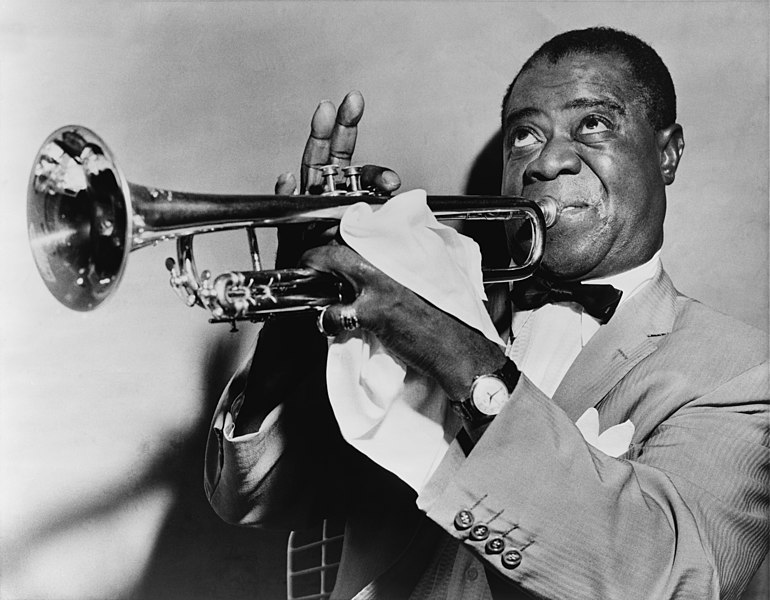
From Gary... Its a wonderful world


File:Louis Armstrong restored.jpg


Wednesday, and a beautiful one it is!!!  The sun is shining, the sky is a wonderful shade of blue and life is good!!!  When I did my usual morning perusal of facebook, I saw this video that brother Ed Healy had posted from you-tube and it brought a little happiness into my life.  Before you look outside to see what the world looks like where you are, read the following.... 

Genesis, Chapter 1
 9  God said, “Let the waters under the sky be gathered together to one place, and let the dry land appear”; and it was so. 10 God called the dry land “earth”, and the gathering together of the waters he called “seas”. God saw that it was good.  11 God said, “Let the earth yield grass, herbs yielding seeds, and fruit trees bearing fruit after their kind, with their seeds in it, on the earth”; and it was so.  12 The earth yielded grass, herbs yielding seed after their kind, and trees bearing fruit, with their seeds in it, after their kind; and God saw that it was good.  13 There was evening and there was morning, a third day. 

  14  God said, “Let there be lights in the expanse of sky to divide the day from the night; and let them be for signs to mark seasons, days, and years;  15 and let them be for lights in the expanse of sky to give light on the earth”; and it was so.  16 God made the two great lights: the greater light to rule the day, and the lesser light to rule the night. He also made the stars.  17 God set them in the expanse of sky to give light to the earth,  18 and to rule over the day and over the night, and to divide the light from the darkness. God saw that it was good.  19 There was evening and there was morning, a fourth day. 

  20  God said, “Let the waters abound with living creatures, and let birds fly above the earth in the open expanse of sky.” 21 God created the large sea creatures and every living creature that moves, with which the waters swarmed, after their kind, and every winged bird after its kind. God saw that it was good.  22 God blessed them, saying, “Be fruitful, and multiply, and fill the waters in the seas, and let birds multiply on the earth.”  23 There was evening and there was morning, a fifth day. 

  24  God said, “Let the earth produce living creatures after their kind, livestock, creeping things, and animals of the earth after their kind”; and it was so.  25 God made the animals of the earth after their kind, and the livestock after their kind, and everything that creeps on the ground after its kind. God saw that it was good. 

  26  God said, “Let us make man in our image, after our likeness: and let them have dominion over the fish of the sea, and over the birds of the sky, and over the livestock, and over all the earth, and over every creeping thing that creeps on the earth.” 27 God created man in his own image. In God’s image he created him; male and female he created them.  28 God blessed them. God said to them, “Be fruitful, multiply, fill the earth, and subdue it. Have dominion over the fish of the sea, over the birds of the sky, and over every living thing that moves on the earth.”  29 God said, “Behold,*n2 I have given you every herb yielding seed, which is on the surface of all the earth, and every tree, which bears fruit yielding seed. It will be your food.  30 To every animal of the earth, and to every bird of the sky, and to everything that creeps on the earth, in which there is life, I have given every green herb for food;” and it was so. 

  31  God saw everything that he had made, and, behold, it was very good. 

If God said it, then that is what it is.  In spite of all the not-so-good things around us, the world is still a wonderful place.  Today, just think about that a bit- and thank God above for what he has given us!!!

From Jim McGuiggan... Letters Of Recommendation


Letters Of Recommendation

It's in this context (see earlier lesson Aroma) that Paul goes into speaking about letters that establish authority (2 Corinthians 3:1). It appears his Jewish (see 11:22) opponents, in one way or another, have raised the question about Paul's authority. Paul had experienced tensions with Jerusalem and Antioch (even with his friend Barnabas) and had no home church to approve of his missionary work so where does he get his commission and authority? He will insist that his letters of recommendation are written on his own heart (following the better-attested reading in 3:2) and on the heart of those who were led to Christ by him. These weren't "external" letters.
Paul's opponents appeared to brag on their Jewish connection (11:21-22) and consequently would be pleased to be identified with Moses. Moses might be well established as God's leader right now but it wasn't always that way. His divine commission was called in question every time he turned around. (This was true of many of the prophets and leaders God called.)
If Moses was doubted it's no big surprise that Paul would be. Moses now fully accepted as God's sent one was doubted even when he had his letters of recommendation straight from God's hand. Moses' letters were written on stone and were external to the people. When Moses appeared with those letters the people had something else written on their hearts--rebellion instead of acceptance. The result was death. The reason death was the result was precisely because the letters (the covenant word) brought by Moses remained external to the people who exchanged their Glory for a grass-eating bull (Psalm 106:20). It was also the case that their apostasy involved the rejecting of God's messenger (Exodus 32:1,23). There are plain implications here for those who reject Paul as God's sent man.
The trouble with letters of recommendation is that they're only worth as much as the people who wrote them, the people who carry them and those who can appreciate them when they're shown to them. If the carrier doesn't have in him what the letter has on the paper, the letter is his judge, and speaks death to him. Letters didn't make the minister worthy--he showed the letters to be true. But it works that way too for those who receive them! If they don't have the heart to appreciate the letters they receive, it's death to them as well. If they think them true and reject the messenger they lose. If they think them untrue when they're true they lose again.
Moses came down the mountain with his own "letters of recommendation" but those letters (which Paul's opponents may have laid special claim to) on tables of stone were not on the hearts of the people to whom he brought them. And the result? When Moses' external letters met evil hearts the result was death (see Exodus 32). When Paul came in the Spirit of the Lord the result was life because the Spirit of Christ wrote in no other place than on human hearts. The Corinthians should have been glad that all that was true. Paul's letter of recommendation is the gospel he brought and the Corinthians had rejoiced in the Holy Spirit and received that gospel Paul carried on his heart. This spoke well of the Corinthians and it should have spoken well for Paul.
It's always true that "the letter" works death. When Paul proclaims and lives out the gospel, in that very process, life and death are ministered (2:16). The good news is not simply an invitation for people to "let Jesus into your heart". It is a proclamation that Jesus is Lord--that's the gospel.
The "letter" is the will of God when it's external to the heart of the person carrying or receiving it. It's something you can talk about as being "out there". It's something you can "possess" without it possessing you. It may the true, of course, but if truth isn't internalised it stands in judgment rather than in approval; it brings (points out) death rather than life. If Paul's "letter," which was written on his own heart, had remained external to the Corinthians it would have meant death to them. Since by the Spirit of God it had been internalised it stood as Paul's letter of recommendation and proof of their own incorporation into Christ with consequent life. All talk about external signs of authority is ill conceived.

©2004 Jim McGuiggan. All materials are free to be copied and used as long as money is not being made.

Many thanks to brother Ed Healy, for allowing me to post from his website, the abiding word.com.

From Mark Copeland... Four Preparatory Acts (14:1-16)


                          "THE GOSPEL OF MARK"

                    Four Preparatory Acts (14:1-16)

INTRODUCTION

1. Following the Olivet Discourse in Mark 13, Mark’s gospel turns its
   attention to events that preceded the betrayal and arrest of Jesus...

2. In the first sixteen verses of Mark 14, we are told of "Four
   Preparatory Acts"...
   a. Two done in opposition to Jesus
   b. Two done in service to Jesus

[Once these four preparatory acts are completed, the stage is set for
the last night and day of Jesus’ earthly life.  In Mk 14:1-2, we are
told how...]

I. LEADERS PREPARE TO KILL JESUS

   A. THE PLOT THICKENS...
      1. This is not the beginning of their machinations - cf. Mk 3:6;
         11:18; 12:12
      2. But now it is two days before the feast of Passover - Mk 14:1
         a. "It was now two days before..." - ESV
         b. "Now the Passover and Unleavened Bread were two days
            away..." - NASB
      3. The plot involves the chief priests, scribes, elders, along
         with Caiaphas the high priest - cf. Mt 26:3-4
      4. Their intention is to take Jesus by trickery (stealth)

   B. THEIR INTENTION TO DELAY...
      1. They did not want to do anything during the feast, lest there
         be an uproar - Mk 14:2
      2. For they feared the people - cf. Mk 11:32; Lk 22:2
      3. Despite their intent, the events are not entirely in their hand
         - cf. Ac 2:23

[Indeed, their plot will be carried out much quicker than intended.  But
before we see why, we read in Mk 14:3-9 that...]

II. MARY PREPARES FOR JESUS’ BURIAL

   A. AT THE HOUSE IN BETHANY...
      1. The home of Simon the leper (perhaps father of Mary, Martha,
         Lazarus) - Mk 14:3
      2. John identifies the woman as Mary, sister of Martha and Lazarus
         - cf. Jn 11:2; 12:2-3
      3. Not to be confused with the woman that anointed Jesus earlier
         - cf. Lk 7:36-50

   B. MARY ANOINTS JESUS...
      1. Using an alabaster jar of expensive perfume - Mk 14:3
      2. Breaking the jar, pouring the perfume over His head, anointing
         and wiping His feet with her hair - cf. Jn 12:3

   C. THE DISCIPLES’ INDIGNATION...
      1. They were angry at what they considered wasteful - Mk 14:4
      2. For the perfume was worth 300 denarii (300 days wages), and
         they thought it better to have sold it and given the money to
         the poor - Mk 14:5
      3. Judas Iscariot especially was angry, not that he cared for the
         poor, but because he often pilfered from the money box - Jn 12:4-6
      4. Thus the disciples criticized Mary sharply - Mk 14:5

   D. JESUS’ PRAISE OF MARY...
      1. Leave her alone, she has done a good work - Mk 14:6
      2. There would always be the poor to help, but not so with Jesus
         - Mk 14:7
      3. She has done what she could, even anointing Jesus for His
         burial (once again, predicting His death) - Mk 14:8
      4. The highest praise?  Mary’s actions will be memorialized - Mk 14:9

[Jesus’ prediction of Mary’s praise was fulfilled by the inclusion of
this story in the gospels of Matthew, Mark, and John.  Sadly, Mary’s
preparatory act is soon followed by a much different one as...]

III. JUDAS PREPARES TO BETRAY JESUS

   A. JUDAS GOES TO THE CHIEF PRIESTS...
      1. With the intent to betray Jesus to them - Mk 14:10
      2. Judas Iscariot, one of the twelve apostles - cf. Mk 10:4
      3. Whom Jesus knew early on would betray Him - cf. Jn 6:70-71
      4. Luke adds that Satan had entered Judas - cf. Lk 22:3

   B. THE AGREEMENT IS MADE...
      1. The chief priests are glad, and promise to pay Judas - Mk 14:11
      2. Matthew records the price agreed for betrayal:  30 pieces of
         silver - cf. Mt 26:15
      3. Judas had previously manifested his greed for money - cf. Jn 12:4-6
      4. Judas then sought for a convenient time to betray Jesus - Mk 14:11

[What a contrast between the preparatory acts of Mary and Judas!
Finally, let’s briefly consider the preparatory act of the disciples...]

IV. DISCIPLES PREPARE TO KEEP THE PASSOVER

   A. JESUS INSTRUCTS HIS DISCIPLES...
      1. The first day of Unleavened Bread arrived - Mk 14:12
         a. When the Passover lamb was to be sacrificed
         b. The day was likely Thursday, Nisan 14 - ESV Study Bible
         c. His disciples asked where He wanted them to prepare to eat
            the Passover
      2. Jesus gives explicit instructions - Mk 14:13-15
         a. For two of His disciples (Peter and John) - cf. Lk 22:8
         b. With either miraculous foresight, or having made prior
            arrangements
         c. To meet a man who will provide a large upper room, furnished
            and prepared

   B. THE TWO DISCIPLES DO AS INSTRUCTED...
      1. They go into the city (Jerusalem) - Mk 14:16
      2. They find it just as Jesus predicted
      3. They prepare the Passover

CONCLUSION

1. With these preparatory acts completed, the stage is now set...
   a. For Jesus to keep the Passover
   b. For Judas to betray Him to the chief priests
   c. For the trial, crucifixion, and death that will lead to His burial

2. Perhaps we should ask, "What sort of preparatory acts are we doing
   today...?"
   a. Are they things that would prove to betray our Lord?
   b. Or things which would show our love and devotion to Him?

3. Every day we do things, small though they may be...
   a. That might be preparatory to greater things
   b. That might prepare us to do good or to do evil

How much better to follow the example of Mary and the disciples, rather
than the example of Judas and the chief priests...!


Executable Outlines, Copyright © Mark A. Copeland, 2011

eXTReMe Tracker