As we heed the gospel call, the Lord adds us to His body,
the church - Ac 2:41,47
That is why it is so important that the gospel not be
perverted in any way - Ga 1:6-9
If the gospel we have obeyed is different from that revealed in
the Scriptures...
By changing either the facts or commands of the gospel...
...then we have not been saved, and the Lord has not added
us to His church!
If the church in your home holds to a perverted gospel...
You may be the nicest people, but you are still unregenerate
people!
You may profess the name of Christ, both as individuals and
as a church, but you are not truly the people of God, nor a
part of "The Church Jesus Built"!
As you give consideration to the gospel, these studies may
prove helpful...
-- These and others studies can be found at the EO website
TO YOUR INTENTION...
Why are you wanting to start a church in your home?
Is it because you can't get along with people in another
congregation?
Is it because you have problems submitting to authority
(e.g., elders)?
The Lord knows your heart, and will bless your efforts only if
proper motivated
To serve the Lord faithfully according to His will
To worship Him in Spirit and truth
To be simply Christians, members of His body, the church
To one day becoming scripturally organized as a church (with
elders and deacons)
-- Remember that unless the Lord builds the house, labor will be
in vain - Ps 127:1
[Having obeyed the gospel of Christ in its purity and simplicity, armed
with the proper intention to serve the Lord in all things, you are ready
to begin. As you meet in your home, be sure to...]
FOLLOW THE NEW TESTAMENT PATTERN
WORSHIP ON THE LORD'S DAY...
The first day of the week, when the disciples came together
- Ac 20:7
The first day of the week, when the disciple laid by in store
- 1Co 16:1-2
-- One may worship other times, but the Lord's day is essential!
WORSHIP IN SPIRIT AND TRUTH...
Engage in prayer
We have several examples of group prayer in the early church
- Ac 4:23-24; 12:5,12
Paul called for prayers to be offered in every place - 1 Ti
2:1,8; 3:15
To provide for the needs of Christians, and to do the work
of the church
-- For more information, see earlier lessons related to the
worship of the church
[Remember that Jesus promised to be wherever even just two or three are
gathered in His name (Mt 18:20). When offered in Spirit and truth,
worship can be just as meaningful in a home as in large building.
Finally, one more thought or two...]
AS YOU CONTINUE
REACH OUT TO YOUR BRETHREN...
Make contact with Christians in other places
Even though they may be too far away to assemble on a regular
basis
Communicate with them via the Internet or by other means
Perhaps they can provide additional materials for your study
and worship
-- It is edifying to know you are not alone in serving Jesus
simply as a Christian
REACH OUT TO THE LOST...
Seek to share the gospel of Christ with family, friends and
neighbors
Offer to have Bible studies with them in your home or theirs
Invite them to your worship on the Lord's Day in your home
-- Don't forget that we have a Great Commission given by our Lord
- Mt 28:18-20
REACH OUT TO THE COMMUNITY...
As you grow, consider renting or building a meeting place other
than your home
Many people are hesitant to worship in a home; as you rent,
then build, it develops credibility as a congregation in the
eyes of the community
Some communities have strict zoning laws regarding the use of a
home for worship; as you grow, the need to rent or buy a
central meeting place will become necessary
-- Consider what will be expedient in your community in reaching
out to the lost - cf. 1Pe 2:12
CONCLUSION
There are certainly benefits to starting a church in a home...
It provides an opportunity for the Lord to bless those in the
neighborhood and community through your presence
It is easier to create a sense of family and closeness among the
members
The commute to services is nice if the church is meeting in your
house
But again, whenever possible we should seek to join ourselves with an
established congregation...
There are benefits and opportunities to be found in a larger group
Especially when a congregation is completely and scripturally
organized
What is important is that we are only seeking to be "The Church Jesus
Built"...
Not some man-made church or denomination
Simply Christians, members of the body of Christ, His church
My prayer is that in some way this series may encourage others who love
Jesus to serve Him as His Word directs, to be nothing more than "The
Church Jesus Built"!
In this series we have sought to examine "The Church Jesus Built" by
studying...
The nature of the church
The authority of the church
The organization of the church
The worship of the church
The work of the church
We noted some of the distinctions between the church universal and
the church local...
The Church 'Universal'
Composed of all Christians
There is just 'one'
Began on the Day of Pentecost
Enter only by being added by the Lord
The Lord keeps the books of membership
Consists of all the saved
Must be in this to be saved
Has no 'earthly' organization
Can't be divided
Death doesn't affect membership
The Church 'Local'
Composed of Christians in one location
There are 'many'
Begins when people join together
Enter by 'joining ourselves'
Enrolled by human judgment
Consists of both saved and lost
Do not have to be in this to be saved
Has 'earthly' organization
Can be divided
Death does affect membership
When we are aware of the difference between the church universal and
local churches, we are better equipped to identify "The Church Jesus
Built" today...
In view of the high estimation placed upon the church as described
in the New Testament, I would like to be able to identify it
today, wouldn't you?
But is our task one of being able to identify the church
universal, or local churches?
[It is the latter question that I wish to address in this study. Let me
begin by asking...]
CAN WE IDENTIFY THE CHURCH "UNIVERSAL"?
ONE POPULAR APPROACH IN EVANGELISM IS AS FOLLOWS...
Jesus said He would build His church, and we read about it in
the Bible
If today you could find that church we read about in the Bible,
wouldn't you want to be a member of it?
Well, here is a chart which shows the pattern of the New
Testament church...
A chart is then used which describes the beginning of the
church (its founder, place and time of origin, and its head)
The chart also lists verses describing the organization,
name, worship, etc., of the church
If you can find the church that is like this in all respects,
then it is the New Testament church today!
THE PROBLEM WITH THIS APPROACH...
Are we not trying to identify the one and true church, i.e.,
the church "universal"?
But charts like the one described above often make no
distinction between the church universal and the church local
E.g., its founder, time and place of origin, head, etc.,
refers to the universal church
Yet passages describing organization, name, worship, etc.,
refer to the local church!
This can easily lead to confusion...
Concerning the church universal
That it may have earthly organization
That it is overseen by elders and served by deacons
Concerning the church local
That they all started in Jerusalem
That they all started in 30 A.D.
It is virtually impossible to identify the church universal in
this way
It has no earthly organization that can be visibly seen
Only the Lord knows...
Those who are truly saved
Those who thereby make up His body, the one true church!
At best, we can only identify local churches today
A MORE SCRIPTURAL WAY TO DISCUSS THE CHURCH...
Regarding the church universal
Emphasize that the Lord is in the process of building His
one true church
Which consists of all the saved, for the Lord adds those
being saved to it
Here is how you can be saved and thereby become a member of
the Lord's church...
Regarding the church local
Once saved, and a member of the body of Christ, the NT
teaches you should "join yourself" with a local congregation
But which one? How can you identify which of the myriad
congregations are considered by the Lord as His faithful
churches in the local sense?
Now let's examine what the NT reveals about the local
church...
[This approach is not only scriptural, it also has less potential for
confusing the universal church with the local church. With this in
mind, here are a few thoughts on...]
HOW TO IDENTIFY THE CHURCH "LOCAL"
THE "NAME" IS A GOOD PLACE TO BEGIN...
The name of a local congregation reveals much
Whether the church is concerned about promoting unity in the
body of Christ
If the name is a denominational name, religious division
must not be a major concern of those in the congregation
The "name" should therefore be a scriptural name
There is no one scriptural name for the Lord's church in the
New Testament
The expressions "church of God" (1Co 1:2), "churches of
God" (1Th 2:14), and "churches of Christ" (Ro 16:16) are
commonly used
Other terms are used also, and all reflecting an
association with God and Christ (body of Christ, kingdom
of God, bride of Christ, temple of God, etc.)
But the use of scriptural names instead of a
humanly-conceived name...
Reflects a desire to follow the Scriptures, and not human
tradition
Certainly conveys a desire to honor God and Christ, and
not some man, creed or particular doctrine
However, the "name" alone is not a sure guide
Just as the name "Mrs. Copeland" alone is not a sure guide
if you were seeking to find my wife
For there are a lot of women who go by the name, "Mrs.
Copeland"
But only one who bears the name is properly my wife!
So there may be many congregations that bear the name of
Christ or God that may not be truly honoring them!
For example, there are over 200 separate denominations
that use the name "Church of God"
Likewise, there may be "Churches of Christ" that are no
less a congregation of the Lord than any with a
denominational name!
-- Yet I would still recommend that one begin with the name, and
in particular those congregations that use the expression
"church of Christ"
EXAMINE THE "GOSPEL" BEING PREACHED...
Remember how Christ is adding people to His church universal
As we heed the gospel call, the Lord adds us to His body,
the church - Ac 2:41,47
That is why it is so important that the gospel not be
perverted in any way - Ga 1:6-9
If the gospel proclaimed by those in a local church is
different...
By changing either the facts or commands of the gospel...
...then people are not being saved, and the Lord is not
adding them to His church!
A church with a perverted gospel...
May have the nicest people, but they are still unregenerate
people!
May wear the name of Christ, both as individuals and as a
church, but are not truly the people of God, nor a part of
"The Church Jesus Built"!
COMPARE THE "PRACTICE" WITH THE NEW TESTAMENT PATTERN...
In the New Testament, we find a pattern regarding local
churches
The NT describes the early church during its first 60 years
A careful study of Acts and the epistles reveal a picture of
the church
From this picture, a pattern emerges in reference to:
The worship of local churches
The work of local churches
The organization of the churches
This pattern emerges as we see the early Christians...
Continuing steadfastly in the "apostles' doctrine" - Ac
2:42
Being taught the same things in every church - cf. 1Co
4:17; 16:1-2
Faithful churches abiding in the "apostles' doctrine" will
reflect this pattern today
Their worship will be like that described in the New
Testament
Their work as a congregation will be similar to that found
in the New Testament
Their organization as a congregation will seek to be like
that described in the New Testament
At the very least, does the local congregation allow you...
To fulfill your obligations related to other Christians?
E.g., gathering on the first day of the week to break
bread? - Ac 20:7
E.g., laying by in store as God has prospered you? - 1Co
16:1-2
To fulfill your obligations without violating your
conscience?
E.g., praising God in song without mechanical instruments
of music?
E.g., using the Lord's treasury for what is the proper
work of the church?
Bear in mind, no congregation is perfect - cf. Re 2:1-7; 3:1-6
Christians are not perfect, though they are to strive toward
perfection
Churches may lack the spiritual fervor we might desire to
see in them
But if a church at least provides the basics for your
spiritual growth and service, then perhaps you can encourage
the other members to grow and serve with you!
CONCLUSION
If we wish to identify "The Church Jesus Built" today...
We cannot point to one group of churches and say "There is The One
True Church!"
b For "The One True Church" that Jesus built...
Is a spiritual entity, a body made up of saved individuals
throughout the world
With no earthly headquarters nor earthly organization
But there are countless individuals who have joined themselves
together as local churches...
Following the apostles' doctrine as revealed in the New Testament
Imitating the pattern seen in the New Testament regarding the
work, worship and organization of the local church
And such churches can be so identified today!
Feel free to contact me if you would like for me to see if I can
find a church in your area
A person's first concern should be to look to the Lord through His
Word to save him, thereby adding him to His church universal
Having done that, he or she should then examine the New Testament to
learn what to look for as one seeks to locate and worship with one of
His local churches
But suppose one is unable to find an established congregation in their
area that is following the New Testament pattern, what then? The answer
will be offered in our next and final lesson in this series...
It can be hindered or distracted from fulfilling its true
purpose
[Among many churches, innovations have been introduced into the work of
the church. Though well intentioned, they tend to denominationalize
and/or secularize the church. One such innovation is...]
INSTITUTIONALISM
INSTITUTIONALISM DEFINED...
The support of human institutions from the treasury of local
churches
"...the doctrine or practice of a church sending money to an
institution of some kind in order to carry out some work
that the church has deemed worthy of support."
- http://www.goodfight.com/notes/Institutionalism.html
"... this may include supporting missionary organizations,
orphan's homes, nursing homes, schools, other churches, even
political organizations." - ibid.
Such institutions are often called 'parachurch organizations'
"The parachurch is effectively a new form of religious
organization that dates from the early 19th century."
"In the first quarter of the 19th century, parachurch
organizations were abundant in many forms -- Bible tract
societies, independent educational organizations,
independent missionary groups, and moral reform
organizations."
"The defining characteristic of a parachurch is that it
stands outside of the organizational structure of well-
established religious bodies."
"Parachurches are often the creation of an entrepreneur or a
small cadre of people who seek to achieve specific goals."
The goal of such institutions are certainly noble: evangelism,
benevolence, edification, etc.
The issue in this study is not whether such institutions
have a right to exist
The issue is whether local churches should support them out
of their treasury
PROBLEMS WITH INSTITUTIONALISM...
There is no scriptural support for churches to support human
institutions
There is no example of NT churches sending money to human
institutions as a way of carrying out their work of
evangelism, edification, or benevolence
The practice began in the 19th century (see above)
In the NT, churches sent money directly to other churches or
individuals
It gives oversight of the local church's work to those not its
elders
Human institutions are governed by board members, CEOs, or
other individuals
Churches 'out source' their work and their oversight by
giving to such organizations
It turns the local church into a collection agency for man-made
organizations
Institutions appeal for churches to support their
organizations
The local church thus becomes a mini 'United Way' for human
institutions
It tends to denominationalize the church
Institutions usually identify their association with a
particular group of churches
E.g., a 'Church of Christ school', or 'Church of Christ
benevolent home', etc.
The use of 'Church of Christ' in such a way contributes to a
denominational mindset
Additional insights regarding the problems with
institutionalism come from an article on Parachurch
Organizations by William McDonald:
"One result is that capable teachers and preachers have been
called away from their primary ministries in order to become
administrators. If all mission board administrators were
serving on the mission field, it would greatly reduce the
need for personnel there."
"Another result of the proliferation of organizations is
that vast sums of money are needed for overhead, and thus
diverted from direct gospel outreach. The greater part of
every dollar given to many Christian organizations is
devoted to the expense of maintaining the organization
rather than to the primary purpose for which it was
founded."
"Organizations often hinder the fulfillment of the Great
Commission. Jesus told His disciples to teach all the things
He had commanded. Many who work for Christian organizations
find they are not permitted to teach all the truth of God.
They must not teach certain controversial matters for fear
they will alienate the constituency to whom they look for
financial support."
"The multiplication of Christian institutions has too often
resulted in factions, jealousy, and rivalry that have done
great harm to the testimony of Christ. 'Consider the
overlapping multiplicity of Christian organizations at work,
at home, and abroad. Each competes for limited personnel and
for shrinking financial resources. And consider how many of
these organizations really owe their origin to purely human
rivalry, though public statements usually refer to God's
will (Daily Notes of the Scripture Union).'"
[Whether individual Christians should support such human institutions is
another issue. There is no authority for local churches to do so, and
it is fraught with problems. The same is true regarding...]
SPONSORING CHURCHES
SPONSORING CHURCH CONCEPT DEFINED...
Where one congregation oversees a work in another area, or the
combined efforts of two or more churches
"One congregation that especially oversees a project such as
a mission society, in which other congregations have an
interest and to which they voluntarily contribute regularly.
The fact that other churches contribute to a project this is
overseen by the elders of one church is the central idea."
- J. D. Thomas, We Be Brethren, p. 355
"A sponsoring church is a congregation which assumes the
oversight and control of some activity in the general field
of evangelism, edification, or benevolence." - Kevin Kay,
Institutionalism: Sponsoring Church
Some examples of sponsoring church arrangements
A church sponsors a foreign work, with its elders overseeing
the evangelist(s) and the congregation(s) in a particular
area
A church sponsors a work beyond its own ability to finance
(e.g., TV, radio), and asks other churches to financially
support its efforts
A church sponsors an evangelist, with other churches
channeling their support of said evangelist through the
auspices and control of the sponsoring church
The sponsoring church concept was developed as an alternative
to parachurch organizations
Many opposed human institutions like missionary societies
This alternative sought to do the same work through churches
rather than societies
PROBLEMS WITH THE SPONSORING CHURCH ARRANGEMENT...
There is no clear scriptural support for the sponsoring-church
concept
Some point to Jerusalem as a 'sponsoring church' - cf. Ac
11:29-30; 12:25
Where supposedly the elders of the Jerusalem oversaw the
work
But the 'elders' in Ac 11:30 are just as likely those of
the churches in Judea
Where supposedly support from other churches were
funneled through Philippi
But Paul's remarks in Php 4:15 refer to the beginning of
the work in Macedonia, and 2Co 11:8 can easily include
support received directly from other churches later
It gives too much oversight to the elders of a local church
Elders were to oversee the flock of God 'among you' - cf. Ac
20:28; 1Pe 5:1-2
Elders of a sponsoring church have oversight beyond the
local congregation
They oversee works in other places, even churches in other
countries
Who gave the elders the right to assume such authority?
It violates the NT pattern for local church autonomy
In the NT, congregations were independent, autonomous
Other than the Lord and His apostles, a congregation was
answerable only to its elders - cf. 1Pe 5:5; He 13:7,17
Elders of the sponsoring church expects churches and
individuals they 'sponsor' to be answerable to them
Sponsoring churches have sought to control the actions and
even the property of churches or works they 'sponsor'
(especially in foreign countries)
It reverses the goal of scriptural cooperation between churches
In the NT, support always worked toward the direction of
equality - cf. 2Co 8:13-14
In the sponsoring church concept, smaller churches send
money to bigger churches
Instead of equality, big churches become bigger at the
expense of smaller churches
It seeks to activate the universal church
The sponsoring church concept was originally developed in
opposition to church supported missionary societies (e.g.,
the American Christian Missionary Society)
The missionary society concept was designed to activate the
universal church
Thus the sponsoring church seeks to accomplish the same as
the missionary society
Yet such efforts lead to the next problem...
It leads to denominationalizing the church
Attempts to activate the universal church lead to
denominationalism
Invariably, such efforts separate those who support such
efforts from those who do not
Before long, groups of churches are identified by whether or
not they support such efforts (e.g., institutional vs.
non-institutional churches)
People begin asking "Are you with us, or them?", sounding
like those in Corinth - cf. 1Co 1:11-12
[Both institutionalism and the sponsoring church concept have done much
to denominationalize churches of Christ. Another innovation has done
much to secularize churches of Christ…]
SOCIAL PROGRAMS
SOCIAL PROGRAMS DEFINED...
Where churches use their funds to offer social programs
Either for their own members
Or for those in their community and beyond
Social programs such as:
Day care centers, schools, counseling services
Orphan homes, disaster relief, medical missions
Family life centers, gymnasiums, racket ball courts
Through such efforts, using the local church to:
Solve social ills in our society
Provide entertainment for young people to keep them
interested and out of trouble
PROBLEMS WITH SOCIAL PROGRAMS...
There is no scriptural support for the church to support social
programs
The church certainly provided benevolence for Christians
- cf. 1Co 16:1-2; Ro 15:26
As individuals we are certainly to be "good Samaritans"
- cf. Ga 6:10; Jm 1:27
But there is no indication that the local church became a
business that offered such a wide range of services
It burdens the local church with activities for which it was
not designed
Notice Paul's concern that the church not be 'burdened'
- cf. 1Ti 5:16
Christians were expected to fulfill their familial duties
- cf. 1Ti 5:8
Thus limitations were placed on who the church could support
- cf. 1Ti 5:9-13
The church has its own work to fulfill (e.g., evangelism,
edification), while the Lord expects individuals, families,
governments, and society at large to fulfill their duties
- cf. 1Ti 5:4,14 (family); Ro 13:3-4 (government)
It has the long term effect of secularizing the church
Secularize - To draw away from religious orientation; make
worldly - American Heritage Dictionary
The effects of secularization on the church through social
programs are evident:
Elders (shepherds, pastors) become board members,
directors, managers
Evangelists (preachers, ministers) become staff managers,
personal counselors
Churches have youth directors, education superintendents,
family counselors, secretaries, janitors, etc.
Losing its spiritual focus, a congregation becomes:
A business instead of a body
A foundation instead of a family
A corporation instead of a church
CONCLUSION
Again, it is not that there are social causes that do not need to be
addressed...
As individuals, Christians can and should make an impact
They can use other organizations such as family, community, or
governmental agencies
Like leaven, their influence may not be as noticeable, but
nonetheless real - cf. Mt 13:33
But do not forget that the local church is limited in its
resources...
It can be hindered or distracted from fulfilling its true purpose
intended by God
History has shown the impact of institutionalism, the sponsoring
church concept, and church involvement in social programs: denominationalism
and secularization
Being 'in' the world, there is the danger of becoming 'of' the world
(cf. Jn 17:14-15). Should we not be content to "let the church be the
church", especially in regards to its work...?
David Sargent, minister, and author of Living Water, relates the unusual story of Dennis Lee Curtis.
In 1992, Curtis was arrested for armed robbery in Rapid City, South
Dakota. In his wallet, police found a list of rules Curtis had written
for himself – guidelines for his robberies. For example, he wrote:
“I will not kill anyone unless I have to.”
“I will take cash and food stamps — no checks.”
“I will not rob mini-marts.”
“If I get chased by cops on foot, I will get away. If chased by
vehicle, I will not put the lives of innocent civilians on the line.”
“I will rob only seven months out of the year.”
“I will enjoy robbing from the rich to give to the poor.”
However, the judge before whom Dennis Lee Curtis stood didn’t consult
his list of rules. He didn’t say, “Well, at least you live by some
values.” No, Curtis was judged by the laws of South Dakota. And
convicted as a thief.
While Curtis’ behavior may seem odd, it’s no more different than
folks who think they can live by their own standard and God will be
pleased.
People often compare themselves to others to judge themselves in a
more favorable light. We may look at the things that we don’t do, to
feel good about ourselves. I don’t commit murder. I don’t steal. I don’t
commit adultery. I don’t get drunk.
Some folks excuse their bad behavior, their sinful habits, or their
lack of self-control, by saying, “At least I’m nice to people. I help
people. And I care about other people.”
Yet, God isn’t going to judge us on the basis of what we don’t do. Or
on a curve system based on the lives of those worse than we are. Or on
our own value system.
I’m reminded of Paul’s concern for Israel. He prayed that they might
be saved. He wrote that they sought to “establish their own
righteousness,” and failed to submit “to the righteousness of God” (Rom.
10:1-3). Our standard of righteousness is not God’s standard. Like
Israel of old “all our righteousness are like filthy rags” (Isa. 64;6).
We are unclean. And by His standard, everyone has sinned and fallen
short of His glory (Rom. 3:23).
When we stand before the Great Judge, he won’t consult our list of
rules or our personal value system. Jesus said, “He who rejects Me and
does not receive My words, has that which judges him; the word that I
have spoken will judge him in the last day” (John 12:48).
However, if we are willing to admit our unworthiness, submit to His
standard of authority, obey His Word, receive His grace, and accept His
offer of salvation through Jesus Christ, we can be saved. We can
experience pardon, find peace, feel His power working in our lives, and
know His purpose for our lives. (Jn. 3:16; I Jn. 2:2; Eph. 1:-1-10; Rom.
6:23).
While none of us will live perfectly sinless lives, we can clothe
ourselves with God’s garments of righteousness. Excel to a higher level
of living. And exemplify His holy standard in our lives.
[EDITOR’S NOTE: AP auxiliary writer Dr. Rogers is the
Director of the Graduate School of Theology and Associate Professor of
Bible at Freed-Hardeman University. He holds an M.A. in New Testament
from Freed-Hardeman University as well as an M.Phil. and Ph.D. in
Hebraic, Judaic, and Cognate Studies from Hebrew Union College-Jewish
Institute of Religion.]
The discovery of the Dead Sea Scrolls is widely regarded as the greatest archaeological discovery of the 20th
century. From 1947 to 1956 about 930 scrolls were found in 11 desert
caves near Qumran, a site about 12½ miles southeast of Jerusalem. Other
discoveries were made in about 11 other sites in the vicinity of the
Dead Sea, but no place yielded the number of manuscripts as Qumran. The
Qumran scrolls span four centuries, from the third century B.C. to the
first century A.D., and are written in four languages, Hebrew, Aramaic,
Greek, and Nabatean, in addition to discovered coins having Latin
inscriptions. The Dead Sea Scrolls are important for the Old Testament
in at least two major ways: (1) they allow us access to Old Testament
manuscripts over 1,000 years older than we previously knew; and (2) they
provide information about the formation of the Old Testament canon of
Scripture.
The Discovery and Publication of the Dead Sea Scrolls
The story has been told often.1
A Bedouin shepherd threw a rock into a cave, heard a crash, and
discovered the Dead Sea Scrolls. This story is not entirely true. First
of all, the broken jar and discovery of the cave took place two days
before the first scrolls were found. There was not one Bedouin shepherd,
but three. One threw the rock, and another entered the cave two days
later without the prior knowledge of his partners. The shepherds took
only a few scrolls, and they had no idea what they were and how much
they were worth. The scrolls removed from what became known as Cave 1
were the “Great Isaiah Scroll” (1QIsaa), the Habakkuk commentary (1QpHab), and the Community Rule (1QS).2
These were slightly damaged in transportation before they could be sold
to a dealer of antiquities, and to a Syrian Orthodox monastery.
When the number and value of the scrolls were determined, other caves
continued to be looted and their contents sold by the Ta‘amireh tribe
to which the shepherds belonged. Once the importance of the scrolls was
determined, both scholars and governmental organizations (initially, of
Jordan, and later, of Israel) became involved in discovering additional
caves and conducting formal excavations. The site of Qumran was
excavated in five consecutive seasons under the leadership of Roland De
Vaux of the Jerusalem-based École Bibliques (1951-1956). Eventually, 10
more caves were discovered in the area of Qumran, Cave 4 alone yielding
fragments of nearly 600 manuscripts.3
The laborious task of deciphering, editing, and publishing the Dead
Sea Scrolls is a drama unto itself. The original scholars entrusted with
the task of publishing the Scrolls were exclusively Christian, and thus
the interests of early researchers tended toward Christian backgrounds
and the relationship of the Scrolls to the New Testament. This fact
irked many non-Christian scholars, especially the Israelis. With the
additions of Israeli scholars Elisha Qimron and Emanuel Tov to the
publication team in the 1980s, this problem was rectified, and now
scholars from all backgrounds work on the Dead Sea Scrolls.
In addition to the racial issues, the early publishing team was small
and very slow to do their work. Between 1950 and 1990 only seven of the
eventual 40 volumes in Oxford University Press’s Discoveries in the Judean Desert
series had been completed. In the 1990s alone, however, 20 additional
volumes in this series appeared. There are two reasons for the
proliferation in publication: First, Emanuel Tov of the Hebrew
University in Jerusalem became the general editor of the series in late
1990. His appointment followed an anti-Semitism scandal that resulted in
then-director John Strugnell of Harvard University being removed from
the post. The scandal was provoked by Strugnell’s comments in the
Israeli newspaper, Ha-aretz.4
Second, Ben Zion Wachholder of Hebrew Union College in Cincinnati,
Ohio, with the help of his student, Martin Abegg, produced a nearly
complete text of the Scrolls from a previously published concordance.5
With the early use of computer databasing, Abegg was able to
reverse-engineer the text of many Scrolls from the concordance. Although
their publication was unauthorized both by the Israel Antiquities
Authority and Oxford University, all agree their publication broke the
hold on the Dead Sea Scrolls, and encouraged scholars to complete the
work of official publication.6
Today all of the discovered, decipherable Scrolls have been published,
and photographs of many of the Scrolls are available on the Internet.
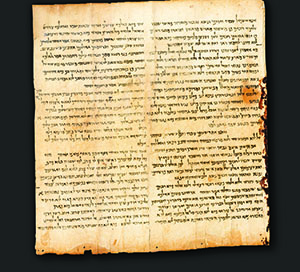
This article provides two examples. Figure 1 is a photograph of two
columns of the Great Isaiah Scroll, featuring Isaiah 53. This scroll is
among the best preserved, and is not typical of the discovered
manuscripts. Figure 2 is a more typical collection of fragments pieced
together by specialists. Most of the Dead Sea Scrolls are, indeed, not
so much scrolls as scraps.
Figure 1: The Great Isaiah Scroll ( ISaiah 53)
Figure 2: A Portion of the Temle Scoll
The Non-Biblical Manuscripts of the Dead Sea Scrolls
It surprises many people to hear the majority of the Dead Sea Scrolls
are non-biblical. Of the approximately 930 scrolls discovered in the
Judean desert, only 222 are biblical (i.e., less than 25%). The
percentage of biblical scrolls is much higher at Judean desert sites
other than Qumran. The biblical texts of Masada, for example, represent
47% of the total number of scrolls discovered.7
We may conclude Jews living in desert communities read many different
books, and were not readers of the Bible alone. This does not
necessarily mean, however, that secular books were read more than the
Bible. In my personal library I have hundreds of books, but my Bibles
take up only about a shelf and a half. Most of these books I do not read
regularly, but my Bibles are in constant use. A similar situation might
have existed for the Dead Sea communities. Still, the non-biblical
Scrolls have relevance for how the Old Testament was understood and
interpreted by some Jews prior to the time of the New Testament.
In order to better examine the non-biblical Scrolls, further
classification is needed. So we shall first discuss works most certainly
not written by members of the Qumran community, what Protestants might
term “Apocrypha” as well as the so-called “Pseudepigrapha.” Then we
shall turn to the “sectarian texts” that were either written by members
of the Qumran sect or were formative for their development as a
community.
Apocrypha and Pseudepigrapha
The term “apocrypha” is a Greek plural substantive meaning “things
hidden.” The term is borrowed from the Church Fathers who used it
frequently to refer to books outside of the canon of Scripture
recognized by the church. The term “pseudepigrapha,” by contrast,
properly refers to writings “falsely ascribed.” Based on this meaning,
the term pseudepigrapha ought to be applied to books such as 1 Enoch
(which was not written by the real Enoch), the Wisdom of Solomon (not
written by Solomon), and so on. But the collection commonly called
Pseudepigrapha now stands for almost any non-canonical book that does
not belong to the Old Testament or to the Protestant “Apocrypha.”
Of the Catholic Church’s “deuterocanonicals” (in Protestant terms,
“Apocrypha”), the Dead Sea Scrolls preserve five copies of Tobit, three
of the Wisdom of Jesus ben Sirah (Ecclesiasticus), and one of the
so-called Epistle of Jeremiah (not actually written by Jeremiah). The
position of the Pseudepigrapha is much better. The mysterious book of 1
Enoch is represented in 12 copies from Qumran, and the book of Jubilees
in no less than 13 and possibly as many as 16 copies (depending on
whether the fragments represent additional manuscripts). There are also
at least five additional compositions related to Jubilees, further
attesting its importance. By manuscript count alone, Jubilees is better
represented than all but four of the canonical Old Testament books
(Psalms, Deuteronomy, Isaiah, and Genesis). Some scholars have suggested
that both 1 Enoch and Jubilees were accepted as canonical Scripture in
Qumran. This is certainly possible, although perhaps it is best to leave
the question open. Popularity does not require canonicity (see more
below).
Sectarian Texts
The Dead Sea Scrolls discovery unveiled many works that were
previously unknown. Since they are associated exclusively with the
Qumran sect, they are normally called “sectarian.” Indeed, some of these
works relate specifically to life in the sectarian community. The most
important are the Damascus Document (CD) and the Rule of the Community
(1QS), which best inform us about life in the community. Other texts are
legal in nature, such as the Temple Scroll (11QT) and miksat ma‘asei ha-Torah
(4QMMT), roughly translated “some matters of the Law.” This latter text
lists grievances the Qumran community had with the Temple and its
officials in Jerusalem.
It will surprise many readers to know that some of the Qumran scrolls
were written in “cryptic scripts.” Scholars believe these scripts are,
in fact, based on the Hebrew language, but have never deciphered them.8
The original editor of these texts distinguished three different
cryptic scripts: “Cryptic A,” “Cryptic B,” and “Cryptic C,”
respectively. As far as we know, these cryptic scripts are used nowhere
else. But they were in prominent use at Qumran. The leader of the Qumran
community (the maskil, or “understanding one”) most likely
communicated in Cryptic A himself, which represents no less than 55
manuscripts. Cryptic B is found in two manuscripts, and the text of
origin remains undeciphered. Cryptic C is found in only one manuscript.
It utilizes the paleo-Hebrew alphabet and five additional letters that
cannot be identified. The individual who manages to decipher these
cryptic scripts will earn lasting fame in the pantheon of scholarship!
More relevant for the text of the Old Testament and how we got the
Bible are two categories of writings: the so-called works of rewritten
Bible and the commentaries (pesharim, or “interpretations”).
Geza Vermes coined the term “rewritten Bible” to refer to Jewish works
written in either Hebrew or Aramaic that paraphrase the Scriptures, and
insert their own expansions and interpretations.9
He primarily had in mind the book of Jubilees, the so-called Genesis
Apocryphon (1QapGen), and Pseudo-Philo’s “Book of Biblical Antiquities.”
The former two works were found among the Qumran scrolls.
These works of “rewritten Bible” are interpretive expansions of
biblical literature. We learn many details, such as the name of Noah’s
wife (“Emzara,” according to Jubilees 4:33), the reason why God chose
Abram (he refused to participate in the building of the Tower of Babel,
Pseudo-Philo chapter 6), and how Abram convinced Sarai to mislead about
being his wife (he dreamt prophetically that she would save him, 1QapGen
column 19). There is no indication that any of these expansions are to
be accepted as legitimate, but they do teach us the ancient Hebrews were
careful and inquisitive readers of the Bible. More importantly for us,
the close following of the biblical text confirms that their Scriptures
followed the exact storyline as ours. There is no evidence that the
Bible has undergone massive changes over time, as some wish to allege. We read essentially the same Bible as they did.
The Old Testament Manuscripts of the Dead Sea Scrolls
The most celebrated of the Scrolls have been the Old Testament
manuscripts. Although some scholars have asserted that fragments of
certain New Testament verses can be located, most scholars agree that no
New Testament copies, quotations, or fragments exist among the Dead Sea
Scrolls.While the Qumran community did in fact exist at the time of
Jesus and the Apostles, there is no evidence that any of the Dead Sea
Jewish communities were aware of the early Christian movement. This
means our discussion of biblical evidence must focus on the Old
Testament. We shall begin by discussing the numbers of manuscripts we
possess before moving to consider issues relating to the canonicity of
the Old Testament.
Biblical Manuscripts by the Numbers
All Judean desert sites show a special respect for the Law of Moses.
The Pentateuch represents 87 of the some 200 biblical Qumran scrolls,
and 15 of the additional 25 texts discovered outside Qumran are of the
Pentateuch.10
In other words, 45% of the total number of texts from the Judean desert
are Pentateuchal. The Major Prophets represent 46 additional
manuscripts, and the Minor Prophets 10 more. So Prophetic books account
for nearly one-quarter of the whole. This leaves 25-30% for the rest of
the Old Testament.
The Historical Books did not fare as well, with only 18 copies. To
illustrate, just one small fragment about the size of a human hand
represents all of 1 and 2 Chronicles, and no copies were identified of
the Nehemiah section of Ezra-Nehemiah (which is a single book in Hebrew)
or of the book of Esther. The Poetic Books, excluding Psalms, represent
14 manuscripts. But 39 manuscripts of Psalms alone were discovered, 36
of which are from Qumran. Broadly speaking, the popularity and
dispersion of biblical scrolls in the Judean Desert matches very closely
what we observe among the books quoted in the New Testament.
Among stand-alone books at Qumran, Psalms takes the crown (39
manuscripts), followed by Deuteronomy (33), Genesis (24), Isaiah (22),
and Exodus (18). Interestingly, four of these five books were in the
“top five list” of books quoted by Jesus: Psalms (11), Deuteronomy (10),
Isaiah (8), and Exodus (7). In fact, Table 1 compares the number of
Qumran manuscripts with the frequency of explicit quotation in the New
Testament. Although books can be used without necessarily being quoted,
Table 1 provides an interesting point of comparison.
Biblical Book
Judean Desert
Manuscripts
New Testament
Quotations
Psalms
39
69
Deuteronomy
33
32
Genesis
24
24
Isaiah
22
51
Exodus
18
31
Leviticus
17
12
Numbers
11
1
Minor Prophets
10
25
Daniel
8
0
Jeremiah
6
4
Ezekiel
6
0
Job
6
1
1–2 Samuel
4
3
Ruth
4
0
Song of Songs
4
0
Lamentations
4
0
Judges
3
0
1-2 Kings
3
3
Joshua
2
1
Proverbs
2
5
Ecclesiastes
2
0
Ezra
1
0
1-2 Chronicles
1
0
Nehemiah
0
1
Esther
0
0
Table 1: Number of Dead Sea Scrolls by biblical book compared with New Testament quotations by biblical book11
The Biblical Manuscripts and the Old Testament Canon
So far we have discussed mostly facts. But what do these facts mean?
It is prudent to remember that absence of evidence is not necessarily
evidence of absence. In other words, if certain books are missing (such
as Esther or Nehemiah) or are poorly represented (such as Chronicles or
Ezra) among the Dead Sea Scrolls, we cannot on that basis alone conclude
that the Qumran community rejected them from their biblical canon. And
the opposite is true: if certain books are well represented among the
Dead Sea Scrolls (such as Jubilees or 1 Enoch), we cannot on that basis
alone conclude that the Qumran community accepted them into their
biblical canon. What books people like to read and what books people
consider inspired may, in fact, be different. We know from modern
experience that certain books of the Bible are underappreciated and
undertaught among Christians. Do we wish to exclude these books from the
canon? Of course not. Again, popularity is not the same thing as
canonicity.
The truth is that the Dead Sea Scrolls are of limited value in
answering Old Testament questions of canonicity. They apparently did not
think in those terms, and never addressed the question of which books
were in and which ones were out. The better question is to ask what the
Qumran sectarians considered authoritative. And in order to answer this
question, we must move beyond simply counting manuscripts. We must
attempt to understand how the biblical literature was used.
We shall start with the name of “Moses,” which occurs over 150 times
in the sectarian manuscripts. All sections of the Pentateuch are quoted
and interpreted as inspired literature. This should not surprise us, for
the Pentateuch was the most popular portion of the Bible among all
Jewish groups at the time of Jesus. But we can go further. The text of
the Prophets is equally authoritative. The Pesher Habakkuk is a
commentary that takes the book of Habakkuk as an inspired prophecy of
the experiences of the Qumran community, and is interpreted clearly in
this fashion. Other prophets, such as Isaiah and Ezekiel, are also
quoted as authorities. While we cannot regard all of the prophets as
equally authoritative based on the way they are quoted (Obadiah, for
instance, is never quoted in this way), most of them can be regarded as
both inspired and authoritative.
“David,” too, appears frequently as a sacred figure. The Qumran
sectarians know the details of his life from Samuel and Chronicles. For
example, “David’s actions ascended as the smoke of a sacrifice [before
God] except for the blood of Uriah, but God forgave him” (CD 5.5–6).
Such high estimation of David’s character explains how the Psalms he
wrote would be considered authoritative. And the Psalms are frequently
quoted as inspired in the Dead Sea Scrolls. In fact, the Old Testament
as a whole can be characterized as “the Law, the Prophets, and David”
(4QMMT fr. 14). Since the Hebrew Bible is generally divided into three
parts—the Law, the Prophets, and the Writings—this threefold division is
extremely important. Jesus’ own division of the Old Testament into “the
Law, the Prophets, and the Psalms” is very similar (Luke 24:44).
Interestingly, although many books and parts of the Old Testament are
quoted as authoritative, to my knowledge Jubilees, 1 Enoch, and none of
the other Apocryphal or Pseudepigraphical books found among the Dead
Sea Scrolls are quoted in this way. The sectarians may have borrowed
language and ideas from these books, and may have been heavily
influenced by their teachings, but they did not consider them on par
with the books of the Old Testament. If these secondary books were
considered in any sense authoritative, they appear never to be quoted as
such and thus used as the basis for doctrine. This is telling. We can
compare the situation to the role of a preacher in a church. Generations
of congregants may know the preacher’s retelling of the Bible better
than they know the Bible itself! Yet when asked if they consider their
preacher as a voice on par with the authority of Scripture, they would
likely reply with an indignant, “Of course not!” Acknowledged authority
may well be different from unrealized influence.
The Dead Sea Scrolls and the Reliability of the Biblical Text
There is no doubt that the Bible has been transmitted faithfully to
us through the centuries, and that the Dead Sea Scrolls further help to
substantiate that truth. Some biblical apologists, however, have often
exaggerated the “confirmation” the Dead Sea Scrolls offer the text of
the Old Testament. Such comments are often made on the basis of the
Great Isaiah Scroll alone, and are sometimes unwisely connected to a
percentage evaluation. For example, I have heard several times, “the
Dead Sea Scrolls confirm the text of the Old Testament in 99% of the
cases.” Not only is such a figure untrue, this whole line of assertion
paints an unrealistic picture of the evidence. First, most of the
biblical Scrolls, as we have seen, are extremely fragmentary, and
therefore cannot offer us a clear basis of comparison for the Bible as a
whole. In fact, the only biblical book to be preserved among the Dead
Sea Scrolls intact is the Great Isaiah Scroll. Even in the Pentateuch
and the Psalms, where the evidence is good, whole sections of the
biblical text are completely missing or extremely lacunose. In these
cases, the Scrolls cannot confirm anything. And we are speaking here of
the best-preserved books. The situation is worse for the other biblical
books.
Second, many apologists exaggerate the similarities and ignore the differences between the texts that can
be compared. For example, the traditional Hebrew Bible preserved in the
two major Medieval manuscripts, the Aleppo and Leningrad Codices,
respectively (the so-called Masoretic Text), fixes the height of Goliath
as “six cubits and a span” (1 Samuel 17:4). But 4QSama, a
Dead Sea Scrolls manuscript dating to the first century B.C., reads in
this passage “four cubits and a span.” This means Goliath is about six
feet, four inches tall instead of the Masoretic text’s gigantic nine
feet, four inches tall. Further, the reading of 4QSama agrees
with the translation of the Greek Old Testament, which read “four
cubits and a span” well before the time of the Medieval manuscripts.
Should we revise the height of Goliath in our Bibles? Most modern
translations have chosen either to ignore our oldest Hebrew copy of this
portion of Samuel, or to relegate the information to a footnote. Why?
Another example from Samuel can be located in a mysterious passage.
The traditional Masoretic text has it as follows: “Then Nahash the
Ammonite came up and encamped against Jabesh Gilead; and all the men of
Jabesh said to Nahash, ‘Make a covenant with us, and we will serve you.’
And Nahash the Ammonite answered them, ‘On this condition I will make a
covenant with you, that I may put out all your right eyes, and bring
reproach on all Israel’” (1 Samuel 11:1-2, NKJV). Nowhere else in the
Bible or in ancient Near Eastern literature do we read eye-gouging as a
covenantal condition. This passage is exceedingly strange and impossible
to explain. But if we look at the oldest Hebrew copy of Samuel, we gain
a bit more clarity.
The NRSV is one of the few modern versions to use the text of 4QSama in their translation of this passage. As a prelude to 1 Samuel 11:1, the NRSV includes the words,
Now Nahash, king of the Ammonites, had been grievously
oppressing the Gadites and the Reubenites. He would gouge out the right
eye of each of them and would not grant Israel a deliverer. No one was
left of the Israelites across the Jordan whose right eye Nahash, king of
the Ammonites, had not gouged out. But there were seven thousand men
who had escaped from the Ammonites and had entered Jabesh-gilead.
This note, found in the oldest Hebrew manuscript of Samuel, explains
two important details. First, it explains the demand for the right eyes
of the Reubenites and Gadites. Second, it explains why the men fled to
Jabesh-Gilead and why Nahash besieged it. Not only is this reading in
the oldest Hebrew copy of Samuel, it actually aids our understanding of
the Bible. Yet most modern English translations reject it.
One more example shall suffice. Hebrew poetry is intricately designed
in ways that English readers simply cannot appreciate. One of the most
complex of their poetic forms is the acrostic poem. The author will
compose a coherent poem beginning each line, verse, or stanza with
subsequent letters of the Hebrew alphabet from ’aleph totav.
Psalm 119 is one of the most famous and indeed one of the most
beautiful pieces of literature in world history. Psalm 145 is an
acrostic as well. But there is one problem: a verse is missing. Psalm
145 walks through every letter of the Hebrew alphabet with the exception
of the letter nun. The Greek Old Testament always had this
missing line, but the later Masoretic manuscripts had lost it somewhere
along the way. Alas, due to the discovery of 11QPsa, the verse can now be restored: “God is faithful in his words and gracious in all his works.”
Let us pause here to make an important observation: these cases we have been discussing are unusual. In fact, there
are relatively few examples of passages that are totally different in
the Dead Sea Scrolls than they appear in the Medieval Hebrew manuscripts.
And the majority of the passages that are different match some other
known version of the Old Testament (usually the Greek translation). This means that the Old Testament has been copied and transmitted with remarkable accuracy. It is not a stretch to say the Hebrew Bible known to Jesus is essentially the same as the one known to us.
All of this leads to the conclusion that the Dead Sea Scrolls sometimes
complicate, but generally confirm, our knowledge of the Old Testament
text.
Conclusion
The Dead Sea Scrolls are important for a number of reasons. First,
they shed light on an otherwise known Jewish group. Actually, the people
who wrote the Scrolls never refer to themselves as Jews. They are
intriguingly vague about their identity. Second, the Scrolls indicate
that certain books of the Bible were more popular than others, a
conclusion we could draw similarly from the New Testament quotations of
the Old Testament.
Third, the use of the Old Testament as an authoritative source for
biblical interpretation and personal and community life matches material
from the New Testament as well. Finally, the discovery of the Dead Sea
Scrolls allows us to access Old Testament manuscripts more than 1,000
years older than we previously possessed. Before the discovery of the
Scrolls, the oldest complete manuscript of any Old Testament book dated
to the 10th century A.D. To be clear, if Moses wrote the Pentateuch in circa
1400 B.C., then our earliest copy of his complete work in Hebrew dated
2,400 years after it was written! It is with justification that the Dead
Sea Scrolls are considered by many the most important biblical
archaeological discovery of all time.
Endnotes
1
The scholar who was involved in and who investigated most carefully the
discovery of the early scrolls is John C. Trever. His investigation is
recorded in his 1965 book, The Untold Story of Qumran (Westwood, N.J.: Revell).
2 A digital interactive copy of these scrolls can be viewed at the following address: http://dss.collections.imj.org.il.
3
A twelfth cave was discovered in 2016, but this cave yielded no
manuscripts. The geology of the region has changed greatly over the past
2,000 years, and it is probable that future caves will be discovered.
4
An English language version of the Israeli reporter’s interview of
Strugnell was printed in the January/February, 1991 issue of Biblical Archaeology Review, (17[1]).
5 The work of Wachholder and Abegg was published in two volumes by the editor of the Biblical Archaeology Review in Hershel Shanks, ed. (1992), A Facsimile Edition of the Dead Sea Scrolls (Washington, D.C.: Biblical Archaeology Society).
6 A detailed account of the role of Hebrew Union College may be found in Jason Kalman (2013), Hebrew Union College and the Dead Sea Scrolls (Cincinnati: HUC Press).
7 See Emanuel Tov (2002), “The Biblical Texts from the Judean Desert,” in The Hebrew Bible as Book: The Hebrew Bible and the Judean Desert Discoveries, ed. Edward Herbert and Emanuel Tov (London: The British Library), p. 141.
8 The most recent editor of these texts presents much of his work in Stephen Pfann (2000), Discovery in the Judean Desert (Oxford: Clarendon), 36:515-574.
9 Geza Vermes (1973), Scripture and Tradition in Judaism (Leiden: Brill, second edition).
10 See Emanuel Tov, “The Biblical Texts from the Judean Desert,” p. 141.
11 For the Dead Sea Scrolls, I use the table published in Flint and VanderKam (2002), The Meaning of the Dead Sea Scrolls
(San Francisco: Harper), p. 150, on whom I depend for much information
in this section. For the New Testament quotations, I use the list
compiled by Crossway
(https://www.crossway.org/blog/2006/03/nt-citations-of-ot/).